The Full Story of Mighty Mouse: The New Adventures
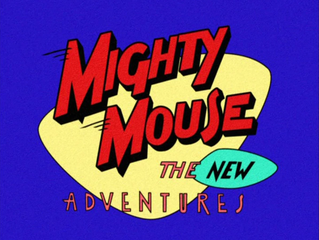
A director walked into CBS with nothing the network wanted, then sold them a cartoon he did not actually own, only to discover the network had owned it all along and forgotten. The show was drawn in a sprint by animators who would go on to make Ren and Stimpy and Pixar movies. And two years later a three-and-a-half-second shot of a mouse sniffing a crushed flower set off a national panic that the star of a children's cartoon was snorting cocaine.
Mighty Mouse: The New Adventures was Ralph Bakshi's revival of the classic Terrytoons character, aired on CBS Saturday mornings from September 19, 1987 to October 22, 1988 across two seasons and 19 episodes. Bakshi produced and supervised it with John Kricfalusi as senior director, over a crew that later shaped modern animation. In June 1988 the American Family Association accused one episode of depicting cocaine use; CBS ultimately backed Bakshi, and the show is now remembered as the start of animation's creator-driven era.
The pitch for a show CBS already owned
In April 1987, Ralph Bakshi took a meeting with Judy Price, the head of CBS's Saturday morning block. Price turned down everything he had prepared, including a pitch built around John Kricfalusi's Ren and Stimpy characters, then asked what else he had. Bakshi told her he had the rights to Mighty Mouse. She agreed to buy the series on the spot.
There was one problem. Bakshi did not own the rights to Mighty Mouse, and he did not know who did. While researching the question, he found the answer inside CBS itself: the network had acquired the entire Terrytoons library in 1955 and forgotten it owned the character. Bakshi has told the punchline the same way ever since. "I sold them a show they already owned, so they just gave me the rights for nothin'!"
Four teams and a week to draw
What followed was one of the fastest starts in Saturday morning history. Kricfalusi's team wrote story outlines for 13 episodes in a single week and pitched them to Price. The next week, Kricfalusi began hiring animators he knew from other studios, artists he later said were "dissatisfied with the formula cartoons they were forced to work on." The show went into production the same month it was greenlit. To hit the September air date, the crew was split into four teams that operated almost independently of one another, each handed a fistful of episodes. The show reached CBS's grid that September; the fall 1987 Saturday morning lineup shows its debut slot, and fall 1988 shows the second season airing under the cloud described below.
Kricfalusi framed the whole enterprise as a rebellion. He called Mighty Mouse the origin of the "'Creator-Driven' revolution" and described the result as "witty, satirical and wildly imaginative" and "quite a revolution when compared to the cartoons being made everywhere else." His stated model was old-school craft. He wanted it to feel "like a Warner Bros. cartoon," restoring a director-unit system in which a few directors owned every creative aspect of a given short. He also said the team stayed "slightly cautious" in what it showed CBS executives.
The roster reads, in hindsight, like a draft board. Among the season-one writers and artists were Andrew Stanton, who would go on to make Finding Nemo and WALL-E at Pixar, Rich Moore, later a director of Zootopia and Wreck-It Ralph, and Jim Reardon, a future writer on The Simpsons and WALL-E. Kricfalusi did not return for the second season; he took part of the crew to make The New Adventures of Beany and Cecil for ABC.
The flower in the palm
The scene that would define the show's public life lasted a few seconds. In the episode "The Littlest Tramp," Mighty Mouse, down on his luck, sniffs the crushed remains of a flower from the palm of his hand. During production, editor Tom Klein flagged it: he worried the shot resembled cocaine use. Bakshi had not watched the footage and thought Klein was overreacting, but he agreed to let the editor cut it.
Kricfalusi objected. He thought the worry was absurd and that the harmless shot should be put back. Following Kricfalusi's advice, Bakshi told Klein to restore the sequence, which had already been approved by CBS Standards and Practices. The episode aired on October 31, 1987, and nothing happened. For seven months, no one said a word.
The cocaine panic
On June 6, 1988, Donald Wildmon, head of the American Family Association, announced that "The Littlest Tramp" depicted a cartoon hero snorting cocaine. The accusation went national within days. The AFA's charge was blunt: it claimed CBS had "intentionally hired a well-known pornographer to do a cartoon for children, and then allowed him to insert a scene in which the cartoon hero is shown sniffing cocaine," a reference to Bakshi's adult film Fritz the Cat.
Bakshi fought back on every front. "I despise drugs. I would be out of my mind to show a cartoon character snorting cocaine in a cartoon," he told the Deseret News in July 1988. To Rolling Stone that September he was more caustic, pointing out that the shot showed exactly what it showed: "He sniffs the petals right out of the palm of his hand." He argued the gesture was ordinary animation grammar. "I mean, there are 8 million sniffs in animation," he said. "Think about it: the sniff is really a staple." He had no doubt why he in particular was the target. "Because of Fritz the Cat. They think I'm a pornographer." Elsewhere he compared the campaign to political persecution: "This all smacks of burning books and the Third Reich. It smacks of McCarthyism. I'm not going to get into who sniffs what. This is lunacy!"
He also, in the end, cut the scene, and he was careful to explain that the two things were not a contradiction. "Mighty Mouse was happy after smelling the flowers because it helped him remember the little girl who sold it to him fondly," he told the Associated Press. "But even if you're right, their accusations become part of the air we breathe. That's why I cut the scene. I can't have children wondering if Mighty Mouse is using cocaine." On CBS's order, Klein removed the roughly three-and-a-half seconds from the master footage for future airings. Wildmon read the edit as a confession, calling it "a de facto admission that, indeed, Mighty Mouse was snorting cocaine." The AFA then demanded Bakshi's removal from the show. On July 25, 1988, CBS instead released a statement backing him.
Bakshi's plan for the fallout was pure Bakshi. He told Rolling Stone the show would answer with a joke: "Mighty Mouse will never go near another flower for the rest of his life. He's not even going to sniff mustard on a hot dog."
How the telling has grown over the decades
- Summer 1988, the frenzy. The story is first told in real time, as a fight. The Deseret News, the Associated Press, The New York Times, and Rolling Stone all run Bakshi's defenses within weeks of Wildmon's June accusation. In those pieces the scene is a scandal, not a legend, and the drama is whether CBS will keep him. It does.
- The retrospective reframe. Over the following years, Kricfalusi and the crew recast the show as a turning point rather than a controversy, the birth of the "creator-driven" cartoon that put artists rather than formula in charge. The alumni roster, from Pixar to The Simpsons, turns the argument into evidence.
- The modern consensus. The show is now filed alongside 1988's Who Framed Roger Rabbit as one of the sparks for the zanier, artist-led animation boom of the 1990s. The flower episode survives as the punchline: the moment a mouse smelling a flower became a congressional-hearing-grade moral panic.
The drift is built into the story. What the scene showed depends entirely on the teller: crushed flower petals to the people who drew it, cocaine to the people who campaigned against it. Whether cutting it settled anything drifts too. To Bakshi the edit was a precaution against innuendo he could not control; to Wildmon it was proof of guilt. Even inside the studio the shot could not hold still: an editor flagged it, a director restored it, a network approved it, and a network then erased it. The dates are fixed. The meaning of three and a half seconds never has been.
The honest bottom line
Mighty Mouse: The New Adventures was made too fast, on a network schedule, by people openly bored with network cartoons, and it lasted only two seasons. Its most famous moment is an accusation that was almost certainly false and that its own creator defused by surrendering the shot rather than the argument. Strip away the hindsight and it is a short-lived Saturday morning revival of a character from the 1940s. What makes it matter is everything that came out of it. It proved a cartoon could be built by artists chasing their own taste instead of a formula, it seeded a crew that would remake American animation, and it turned a smear into a case study in how a few frames can be read into anything. The flowers were just flowers. The revolution was real. Pee-wee's Playhouse was doing the same thing from a bigger stage: making children's television by and for people who thought children deserved better than what they were getting.
Sources
- Rolling Stone, "Ralph Bakshi: Defending Mighty Mouse," Ben Svetkey, September 22, 1988 (Bakshi's contemporaneous defense, quoted verbatim).
- UPI, "Did Might Mouse sniff or snort?", June 9, 1988. Carries CBS program-practices vice president George Dessart's June 8 letter to Wildmon verbatim, including the "three seconds of airtime have been taken out of context" reply. Read in full.
- UPI, "Mighty Mouse is no rat, CBS declares", June 10, 1988 (CBS's denial of the cocaine charge). Read in full.
- UPI, "CBS removes 'misinterpreted' Mighty Mouse segment", July 25, 1988. Carries the CBS statement backing Bakshi ("nothing whatsoever improper") and Bakshi's own "taken totally out of context" quote. Read in full.
- Los Angeles Times, "FIRST OFF . . .", July 26, 1988. Carries the 3 1/2-second cut and Wildmon's "de facto admission" quote verbatim. Read in full.
- The Deseret News ("I despise drugs" quote, Joseph Walker, July 19, 1988), the Associated Press via The Milwaukee Journal (the "air we breathe" quote, July 25, 1988) and The New York Times (Craig Wolff, July 26, 1988) are the outlets of record for the three Bakshi quotations above. Those quotations are carried here as reproduced in the Wikipedia article cited below; the original pieces were not read directly and are therefore not linked.
- John Kricfalusi's own writings on the production (the "creator-driven revolution," the four-team system, the Warner Bros. model), as cited in the show's production record.
- Hal Erickson, Television Cartoon Shows: An Illustrated Encyclopedia, 1949 Through 2003 (McFarland, 2005), pages 546 to 549 (run, network, and production facts).
- Wikipedia, "Mighty Mouse: The New Adventures" (air dates, seasons, episode count, crew, and the controversy timeline, cross-checked against the primary sources above).
Here he comes to save your afternoon, over in the watching room. More show stories live at /full-story/. Related: the full story of the Garbage Pail Kids cartoon and the full story of You Can't Do That on Television.
Frequently asked
Was Mighty Mouse really sniffing cocaine?
No. In the episode "The Littlest Tramp," Mighty Mouse sniffs the crushed petals of a flower a girl had given him. Ralph Bakshi and the crew maintained it was a flower, not a drug; the American Family Association's Donald Wildmon claimed otherwise in June 1988. CBS ultimately backed Bakshi.
Who made Mighty Mouse: The New Adventures?
Ralph Bakshi produced and supervised the revival for CBS, with John Kricfalusi as senior director in season one. The crew included future Pixar director Andrew Stanton and future Zootopia director Rich Moore.
How did Ralph Bakshi get the rights to Mighty Mouse?
He pitched CBS a show he did not own, then discovered CBS had bought the entire Terrytoons library in 1955 and forgotten it owned the character. In his words, "I sold them a show they already owned, so they just gave me the rights for nothin'."
Why was Mighty Mouse: The New Adventures controversial?
On June 6, 1988, the American Family Association accused one episode of showing cocaine use. The resulting media panic ran for weeks before CBS issued a statement supporting Bakshi on July 25, 1988. Bakshi agreed to cut the few seconds in question from future airings.
When did Mighty Mouse: The New Adventures air?
It ran on CBS Saturday mornings from September 19, 1987 to October 22, 1988, two seasons and 19 episodes.
Why is the show considered important?
It is widely credited as the start of animation's "creator-driven" era, giving artists control over the work, and its crew went on to shape Ren and Stimpy, Pixar, and The Simpsons.