The Full Story of You Can't Do That on Television
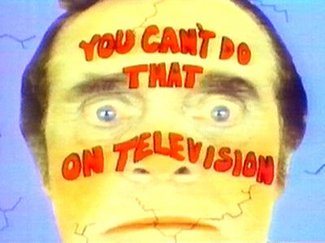
A bucket of cafeteria slop sat backstage at an Ottawa TV station for a week, grew eight inches of green mold, and got dumped on a child actor anyway because the crew was out of time. A sketch show whose name came from a George Carlin routine became the biggest thing on a cable network that barely existed. And the people who made it have spent forty years telling the story, never quite the same way twice.
You Can't Do That on Television was a Canadian kids sketch comedy created by Roger Price and Geoffrey Darby. It premiered February 3, 1979 on CJOH-TV in Ottawa, joined Nickelodeon's schedule in January 1982, and became the network's highest-rated show by 1983. It invented Nickelodeon's green slime, dumped on anyone who said "I don't know," and ran until 1990, launching Alanis Morissette and Big Bang Theory co-creator Bill Prady along the way.
A local show with a forbidden name
Roger Price was a British producer who had made children's television in the U.K. before moving to Canada. The Hollywood Reporter's 2024 anniversary piece describes his goal as a show that respected kids' perspectives and did not condescend to them. Price himself was not sentimental about childhood; he had endured a rough one, including boarding school in Switzerland.
In Ottawa he teamed with Geoffrey Darby, a young CJOH director bored of directing news. "We decided to do a 'kids Saturday Night Live,'" Darby told Vulture in 2012. The pilot-era project had no name at all. "It was actually called The Unnamed Children's Project up until then," Darby said. "We were throwing around ideas, and someone mentioned George Carlin's bit about some of the words you can't say on television. We started playing from that idea. And from that came the title You Can't Do That on Television."
The mission statement, in Darby's words: "It wouldn't necessarily be anti-adult, but a pro-kid show."
The hour-long local program premiered February 3, 1979 with sketches, music videos, live phone-in contests, and local disco dancers. Kids played kids putting on their own TV show, surrounded by incompetent adults. Two grown-ups did nearly all the adult work: Les Lye, who played Ross the stage director, Barth the burger-joint owner, the dungeon master, and dozens more, and Abby Hagyard, who joined as "Mom" in 1982. "With 30-second sketches, there's no room for filler," Hagyard told The Hollywood Reporter in 2024.
The bucket that sat for a week
The signature gag arrived by accident, and Darby has told the story in detail. The dungeon set had a joke: "Whatever you do, kids, don't pull on that chain." The payoff called for fake sewage, so the crew improvised.
"We went to the cafeteria and got them to give us a bucket of slop," Darby told Vulture in 2012. "We want you to take all the stuff that's left on plates over the whole day and put it in this bucket." Child labor law stopped the shoot before the scene was filmed, so the set was rebuilt the following week. The prop man had not made a fresh bucket.
"There was about eight to ten inches of green crud. Growing. It had grown on the top of this bucket of... stuff. There was mold," Darby said. "So, we had to get the scene, right? We couldn't get more slop, because we couldn't! I said, 'Dump... it... on... the... kid... anyway.' And that's how green slime was invented."
The kid was Tim Douglas. Of that first batch, Darby said: "It was really evil. And, God, did it smell!" The audience response was so strong the team "wrote a show with nothing but slime in it."
The other version of the story
The props department remembers it differently. Bill Buchanan, a crew member for the show's entire run, told Mental Floss in 2012 that a rundown once called for "this kinda disgusting slimy green stuff" with no explanation of its purpose. Propmaster Paul Copping mixed a garbage can full of it, colored with green latex paint, and the can festered in a corner of the studio while people walked around it. In Buchanan's telling, when the crew learned the stuff was meant to be dumped on an actor, the prop team argued that it might be harmful, the sketch got pulled, and a safe batch was mixed before anyone was slimed: green Jell-O liquefied from the fridge and thickened with flour.
The two tellings agree on the essentials: a can of green muck went foul in the studio, and the sliming gag was born around it. They disagree on the punchline, whether the rotten batch actually landed on a child. Neither man has publicly reconciled the versions, and this page will not pretend they match.
The recipe kept evolving either way. Mental Floss traced it from Jell-O and flour to cold Cream of Wheat stirred with green food coloring, plus a couple of drops of baby shampoo so it would wash out of hair. Darby, in 2012, still refused to reveal ingredients, confirming only that the slime was edible and non-toxic.
"I don't know" and the fifty-dollar horror
Once slime worked, the show needed a repeatable trigger. "We needed a joke to get the slime dumped," Darby told Vulture. "We needed one where you could not, no matter what you did, answer the question right. And the joke was, 'Name the largest lake in Canada.' Kids would know that, because this was when we were still on the local level. 'How many fish are in it?' You can't know that answer, right? And so the kid would go, 'I don't know.' That's all it was. We needed a cue word."
Saying "water" earned a drenching from above; the word "I don't know" earned the slime. Every sliming and watering came with hazard pay, and the number is remarkably stable across the tellings: fifty dollars. Darby confirmed the bonus to Vulture in 2012. Christine McGlade, the show's original host, put figures on it in a 2015 interview: "we got paid $50 extra for a sliming and $25 extra for water." The Hollywood Reporter's 2024 piece cites the same $50 "inconvenience fee."
Darby also gave Vulture the theory behind the mess: "That really is a leveler. It's violent, but it's not violence. It's safe... You're pulling these people who are on pedestals down. Green slime was about trying to give a comeuppance to kids on TV so audiences at home wouldn't feel so 'jealous' of them."
Nickelodeon finds it
The road from Ottawa to America was not straight. A national CTV version called Whatever Turns You On debuted in September 1979 and was cancelled that December after 13 episodes. Production resumed locally in 1981, and Price and Darby cut the episodes into half-hour syndication edits with the Canadian references removed. Those edits caught the eye of a young cable network. Nickelodeon test-aired them in 1981, liked the response, and put the show into rotation in January 1982. By 1983 it was the network's highest-rated program, and new episodes were being made with Nickelodeon as a production partner. What the channel was when it picked the show up, a small acquired library and a lot of hours to fill, is on Nickelodeon in the 80s.
The cast turned over constantly by design; Les Lye was the only performer in every season. McGlade, nicknamed "Moose" since age nine, hosted from the first episode until her departure in 1986. Alanis Morissette appeared in five episodes and, per The Hollywood Reporter, impressed castmates by playing her demo tape between takes. Writer Bill Prady went on to co-create The Big Bang Theory. Late seasons shrank to five episodes in 1987 and again in 1990, when production ended. Nickelodeon aired reruns until January 1994, then filled the slot's legacy with a new sketch show: All That.
How the telling has grown over the decades
- 2012, Vulture. Mathew Klickstein, writing as the self-described biographer of Nickelodeon's golden age, publishes the foundational Darby interview: the moldy bucket, Tim Douglas, the largest-lake joke, the leveler theory, and Darby's claim that "the kids hated it. They hated getting slimed." Darby also reveals he himself refused to ever be slimed.
- 2012, Mental Floss. Matt Soniak's props-department account (Buchanan and Copping) lands the same year, with the competing no-kid-was-slopped version and the recipe history. The two 2012 stories have circulated side by side ever since.
- 2015, Kickin' It Old School. McGlade's interview softens the "hated it" claim from the inside: "I didn't really mind getting slimed or having water dumped on me: it was always at the end of the day so I could clean up afterwards." The $50/$25 figures enter the record from a performer.
- 2020, CBR. The Darby telling is retold nearly verbatim as a "TV Legends Revealed" entry and ruled TRUE, cementing it as the canonical version online.
- 2024, The Hollywood Reporter. The 45th-anniversary piece adds Roger Price's motive for the trigger phrase, that his own kids used "I don't know" to duck responsibility, and cast member Adam Greydon Reid inverts the feeling entirely: "It was an honor to be slimed." Price, on a possible revival: "It has to really make kids feel like it's their show."
The drift is real and worth naming. Whether the first slime ever hit a child depends on whose 2012 interview you believe. Why "I don't know" became the trigger has two explanations, Darby's mechanical one from 2012 and Price's parental one reported in 2024. And how the kids felt about the goo has been told three ways: they hated it (Darby), it was fine and paid well (McGlade), it was an honor (Reid). Aggregator retellings blur it further; more than one recent summary compresses the timeline into "Nickelodeon premiered the show in 1979," which is wrong on both the network and the role it played. The dates in the record are not in dispute. The memories are.
The honest bottom line
You Can't Do That on Television was cheap, repetitive, and built on maybe a dozen recurring jokes, and its most famous invention was literally a health hazard the first time it appeared, in at least one telling. The kids were amateurs, the sets were plywood, and the show leaned on the same cue words for a decade. None of that mattered. It treated its audience as people whose side someone was finally on, and it handed a fledgling network its entire identity in a bucket. Nickelodeon has been pouring that bucket on celebrities ever since, and every drop traces back to an Ottawa cafeteria. Out of Control was its direct descendant, made by some of the same people in a different city, and the gap between the two tells you what happens when the chaos is planned rather than found.
Sources
- Vulture, "So You Think You Can't Do That on Television?", Mathew Klickstein interview with Geoffrey Darby, 2012.
- Mental Floss, "How Did Nickelodeon Make Green Slime?", Matt Soniak, 2012.
- Kickin' It Old School, interview with Christine McGlade, 2015 (republished by Rediscover the '80s, 2017).
- CBR, "Was Nickelodeon's Famous Green Slime Created By Mistake?", Brian Cronin, 2020.
- The Hollywood Reporter, "'You Can't Do That on Television' and the Slime Boosted Ratings", Ryan Gajewski, 2024.
- Wikipedia, "You Can't Do That on Television" (air dates, season, and network record, cross-checked).
You CAN do that on this television, it is on in the other room. More show stories live at /full-story/. Related: the complete history of Nickelodeon slime and the full story of Double Dare.
Frequently asked
Why did they slime people on You Can't Do That on Television?
The green slime fell on anyone who said "I don't know." Co-creator Geoffrey Darby has said the trigger was pure mechanics, a cue word inside an unanswerable-question joke, while a 2024 Hollywood Reporter piece reports Roger Price chose the phrase because his own kids used it to dodge responsibility.
What was the green slime made of?
It changed over the years. Accounts from the crew describe early batches of green Jell-O and flour, later replaced by cold Cream of Wheat with green food coloring and a little baby shampoo. Darby has only ever confirmed it was edible and non-toxic.
Was the first slime really rotten?
In Darby's telling, yes: a week-old bucket of cafeteria slop with visible mold was dumped on cast member Tim Douglas. In crew member Bill Buchanan's telling, the foul batch was refused and a safe one was mixed first. The two versions have never been reconciled.
When did You Can't Do That on Television air?
It premiered February 3, 1979 on CJOH-TV in Ottawa, joined Nickelodeon in January 1982, ended production in 1990, and reran on Nickelodeon until January 1994.
Was Alanis Morissette on the show?
Yes. She appeared in five episodes and reportedly played her demo tape for castmates. Big Bang Theory co-creator Bill Prady also came out of the show's writing ranks.
Did the kids get paid extra for being slimed?
Yes, and the figure is consistent across decades of tellings: $50 per sliming, $25 for a watering, described by Darby as a reward "for the horror of having that done."