Saturday Morning Fall 1982: ABC, CBS and NBC Cartoon Lineup

By fall 1982 the arcade had followed kids home to the television. The quarter-eating machine every kid in America was lined up for that year turned up on Saturday morning as a cartoon, and the networks spent the season proving that anything with a recognizable name, a video game, a sitcom, a child star, could be turned into animation.
On Saturday morning in fall 1982, ABC debuted The Pac-Man/Little Rascals/Richie Rich Show, the first cartoon built on an arcade video game, inside a ninety-minute block. NBC expanded The Smurfs to ninety minutes and added The Incredible Hulk and the Amazing Spider-Man. CBS moved Captain Kangaroo to Saturdays and filled the morning with Gilligan's Planet, Pandamonium, and Meatballs and Spaghetti. Pac-Man was the season's signature, the moment Saturday morning started mining the arcade for characters.
ABC · fall 1982
| Time | Show |
|---|---|
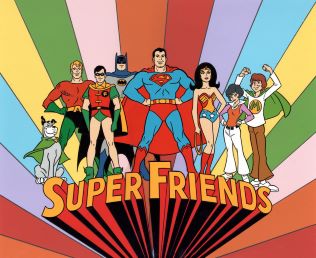
| 8:00 | The Best of the Super Friends (Schoolhouse Rock! at 8:25) |
| 8:30 | The Pac-Man/Little Rascals/Richie Rich Show |
| 10:00 | The Mork & Mindy/Laverne & Shirley/Fonz Hour (Schoolhouse Rock! at 10:55) |
| 11:00 | The Scooby & Scrappy-Doo/Puppy Hour (Schoolhouse Rock! at 11:55) |
| 12:00 | ABC Weekend Special |
| 12:30 | American Bandstand |
ABC went all in on the packaged block. Pac-Man shared a ninety-minute hour and a half with the Little Rascals and Richie Rich, and the network animated its own prime-time hits into the Mork and Mindy, Laverne and Shirley, and Fonz hour. It was the clearest sign yet that Saturday morning had become a place to re-sell things kids already knew from somewhere else.
NBC · fall 1982
| Time | Show |
|---|---|
| 8:00 | The Flintstone Funnies |
| 8:30 | Shirt Tales |
| 9:00 | The Smurfs |
| 10:30 | The Gary Coleman Show |
| 11:00 | The Incredible Hulk and the Amazing Spider-Man |
| 12:00 | The Jetsons (rerun) |
| 12:30 | The New Adventures of Flash Gordon |
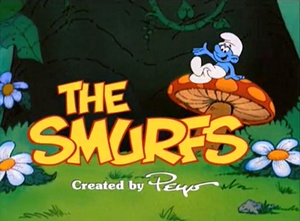
NBC pushed its winning hand. The Smurfs, the breakout of 1981, grew from one hour to ninety minutes and moved to the center of the morning. Around it NBC added Shirt Tales, a cartoon about zoo animals, the Gary Coleman Show, built on the Diff'rent Strokes star, and a Marvel hour pairing the Incredible Hulk with the Amazing Spider-Man. NBC was the network that had figured out how to win Saturday, and 1982 was it pressing the advantage.
CBS · fall 1982
| Time | Show |
|---|---|
| 7:00 | Captain Kangaroo |
| 8:00 | Speed Buggy (rerun) |
| 8:30 | The Sylvester & Tweety, Daffy, and Speedy Show |
| 9:30 | The Bugs Bunny/Road Runner Show |
| 10:30 | Gilligan's Planet |
| 11:00 | Pandamonium |
| 11:30 | Meatballs and Spaghetti |
| 12:00 | The Popeye and Olive Comedy Show |
| 12:30 | The New Fat Albert Show |
| 1:00 | Blackstar |
| 1:30 | CBS Saturday Film Festival |
CBS ran the longest morning of the three, opening at 7:00 with Captain Kangaroo, which after decades as a weekday institution had been pushed to the Saturday schedule. The oddest new entry was Gilligan's Planet, which stranded the castaways in outer space, with most of the original cast back to voice their roles. The morning still ended on the live-action movie block, the CBS Saturday Film Festival.
Pac-Man, by the numbers
The Pac-Man cartoon premiered on ABC on September 25, 1982, produced by Hanna-Barbera under license from Namco, and it ran 44 episodes across two seasons before ending on November 5, 1983. It was the first cartoon built on a video game, and its success moved fast: rival CBS immediately commissioned Ruby-Spears to build Saturday Supercade, an anthology built the same way from other arcade licenses, for the following season. The two shows shared an odd bit of corporate plumbing, since Ruby-Spears and Hanna-Barbera were both Taft Enterprises properties at the time, meaning the arcade-cartoon boom on two competing networks traced back to the same ownership group. Comedian Marty Ingels voiced Pac-Man, a role he landed after a wrong-number phone call connected him to a Hanna-Barbera executive who happened to be casting the part. The gamble paid off immediately: trade press reported the show as the highest-rated Saturday morning cartoon in the country in late 1982, with an audience topping 20 million children on its debut alone, not counting the adults watching along. The show's Pac-Land setting also fed back into the arcade it came from, inspiring Namco's own 1984 arcade game Pac-Land. The cartoon built a whole family around the arcade character: Pac-Man got a wife, Ms. Pac-Man, a baby named Pac-Baby, and a dog and cat, all living in a spherical-architecture world under constant siege from the four Ghost Monsters and their boss Mezmaron, whose sole goal was seizing the Power Pellets that fed the entire city, a plot engine that gave the writers a built-in excuse to restage the arcade chase every week. The second and final season expanded the cast further, introducing Super-Pac and Pac-Man's teenage cousin P.J., both drawn straight from later entries in the Namco arcade catalog rather than invented from scratch for television.
Why Gilligan's Planet became a punchline
Gilligan's Planet premiered on CBS on September 18, 1982, and ran a single season of 13 episodes, making it Filmation's last new Saturday morning cartoon before the studio shifted entirely to syndicated programming. Most of the original live-action cast returned to voice their animated selves, including Bob Denver, Alan Hale Jr., Russell Johnson, Jim Backus, Natalie Schafer, and Dawn Wells. The premise, that the Professor had built a working spaceship only for the castaways to crash on another deserted world and remain just as stuck, is the kind of one-season, one-joke idea that shows how thin the licensing well had gotten by 1982: a hit show's cast reassembled to be stranded a second time, in a slightly different color of nowhere. It was also a studio milestone of a quieter kind: Gilligan's Planet was the first Filmation series to carry producer Lou Scheimer's name alone in the credits, replacing the rotating Scheimer/Norm Prescott "wheel" credit the studio had used since 1969, and one of the last 1980s Saturday morning cartoons fitted with an old-fashioned adult laugh track, a studio-comedy holdover that was already falling out of use by 1982.
What changed from 1981
The arcade arrived: Pac-Man gave ABC the first video-game cartoon and the template for a decade of them. NBC doubled down on the Smurfs, stretching it to ninety minutes, and added the Gary Coleman and Marvel entries. CBS reshuffled hardest, moving Captain Kangaroo to weekends and cycling in Gilligan's Planet, Pandamonium, and Meatballs and Spaghetti. The interstitials stayed put, with In the News on CBS and Ask NBC News after most NBC shows.
The honest bottom line
Fall 1982 is where the pattern gets hard to defend. A huge share of the morning was licensed from somewhere else, an arcade machine, a prime-time sitcom, a movie star, and animated as cheaply as possible to sell the name back to kids on a Saturday. Several of these shows were thin even by the standard of the era. What survives is not the quality but the specific memory: the year Pac-Man made the jump from the arcade to the couch, the year the Smurfs owned the middle of the morning. The cash-in was real. So was the feeling of finding your arcade obsession waiting on channel after channel.
Sources
- Wikipedia, "1982-83 United States network television schedule (daytime)", Saturday section. The half-hour grid on this page is parsed directly from that article's wikitext, by colspan and rowspan, for exact slotting; the wikitext was saved verbatim at gate time. Wikipedia's own cited underlying archive for the network daytime pages is curtalliaume.com, via Internet Archive captures.
- Wikipedia, "<a href="https://en.wikipedia.org/wiki/Pac-Man_(TV_series)" target="_blank" rel="noopener">Pac-Man (TV series)</a>", premiere and end dates, episode and season counts, "first video game cartoon" claim, highest-rated-cartoon and 20-million-viewer debut figures (sourced in the article to Cash Box, November 1982 and Electronic Fun with Computers & Games, February 1983), the Pac-Land arcade-game influence, the Saturday Supercade / Taft Enterprises connection, and the Marty Ingels casting story.
- Wikipedia, "<a href="https://en.wikipedia.org/wiki/Gilligan%27s_Planet" target="_blank" rel="noopener">Gilligan's Planet</a>", premiere date, single-season/13-episode run, returning cast list, its status as Filmation's last new Saturday morning cartoon, the Lou Scheimer solo-credit milestone, and the laugh-track detail.
- Method note: only the three broadcast networks' Saturday morning grids are reproduced here. No independent, UHF or cable lineup is claimed for this season.
Part of the Saturday morning 80s time-capsule series. Previous year: Saturday Morning Fall 1981. Next year: Saturday Morning Fall 1983.
The 1982 lineup lives on in the glowing front room.
Frequently asked
What cartoons came on Saturday morning in 1982?
On ABC: Super Friends, Pac-Man, the Little Rascals, Richie Rich, the Mork and Mindy and Fonz hour, and Scooby-Doo. On NBC: the Flintstone Funnies, Shirt Tales, the Smurfs, the Gary Coleman Show, and the Incredible Hulk with Spider-Man. On CBS: Bugs Bunny, Gilligan's Planet, Pandamonium, Popeye, Fat Albert, and Blackstar.
When did the Pac-Man cartoon come out, and how many episodes were made?
The Pac-Man cartoon premiered on ABC on September 25, 1982, as part of the Pac-Man/Little Rascals/Richie Rich Show, and ran 44 episodes over two seasons before ending November 5, 1983. It was the first Saturday morning cartoon based on an arcade video game.
Was the Smurfs still on in 1982?
Yes. After breaking out in 1981, the Smurfs expanded from a one-hour block to ninety minutes on NBC in fall 1982 and anchored the middle of the network's morning.
What was Gilligan's Planet?
Gilligan's Planet was a CBS cartoon, premiering September 18, 1982, that put the castaways from Gilligan's Island on an alien world after they built a spaceship. Most of the original live-action cast returned to voice their animated selves, and the show ran a single 13-episode season, the last new Saturday morning cartoon Filmation produced before moving to syndication.
What time did Saturday morning cartoons start in 1982?
ABC and NBC started their cartoon blocks at 8:00 a.m. CBS opened earliest, at 7:00, with Captain Kangaroo before its cartoon lineup began.