The Obstacle Course: How Double Dare Built TV's Messiest Minute
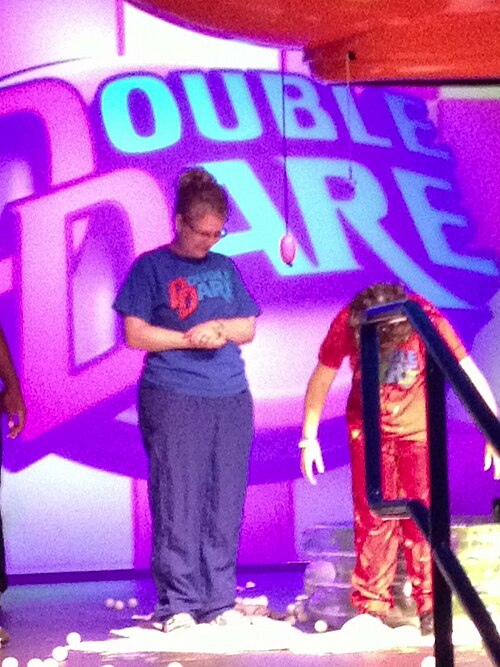
Eight to ten stagehands once carried a seven-foot wedge of Swiss cheese three blocks through the streets of Philadelphia because it would not fit in the truck. A crew spent a winter heating fifty buckets of gelatin and setting them outside to cool so they could pour 500 gallons of Jell-O into a tank. And a septic-truck driver, hired to pump out a week-old vat of baked beans, took one look and said it was the most disgusting thing he had ever seen. That was the obstacle course, the ninety seconds that made Double Dare famous.
The Double Dare obstacle course was designed by set designers Jim Fenhagen and Byron Taylor under co-creators Geoffrey Darby, Mike Klinghoffer, and Bob Mittenthal, built in about two and a half months on the show's under-$10,000-per-episode budget. The team engineered roughly 40 rotating obstacles, from the One-Ton Human Hamster Wheel to a giant nose you had to pick, running eight per course off a graph-paper layout. It became the most memorable segment of Nickelodeon's first game show, and the messiest minute on 1980s television.
For the full story of how Double Dare itself came together, from the Nabisco sales pitch to the Mouse Trap board game to host Marc Summers, see the full story of Double Dare. This is the story of the course.
The ending the game needed
The obstacle course was not the original plan; it was a solution. The game began as a trivia contest, and the creators realized it needed a finish. Not everyone was sold on the fix. "I kind of hated the obstacle course in the beginning, even though it's clearly everybody's favorite part of the show," co-creator Bob Mittenthal told the A.V. Club's 2016 oral history of the segment. "Everyone was like, 'Let's just do an obstacle course,' and I was like, 'That has nothing to do with the rest of the show.'" His model was ABC's Battle Of The Network Stars, whose obstacle event was "really cool and really visual and physical." What married it to Double Dare was the goo. "I guess the thing that tied it all together was the idea of the mess," Mittenthal said.
The first attempts were forgettable. "It really started with traditional obstacles. It was a wall that we could try and put a rope on," co-creator Mike Klinghoffer said. "It really was the sort of classic military obstacle course to some degree... but we always knew that we were going to mess them up. We probably had four obstacles at the start, and I would say that probably none of them lasted very long. They were boring." A short list of keepers emerged fast. "The human hamster wheel, the Wringer, the Sundae Slide, and the tank were probably the immediate ones that we knew we always wanted," Klinghoffer said. "We always knew we wanted a tank that we could constantly fill with things."
Cheap on purpose
Every design decision ran through one number: the show had promised to come in under $10,000 an episode. That constraint is why some obstacles were almost aggressively simple. "That's why we ended up with some inexpensive obstacles, like a pillowcase full of feathers or a bunch of balloons with a flag in one of the balloons," executive producer Geoffrey Darby said. "We had those kinds of things scattered amongst the other obstacles, because we only had so much money for the set and stuff."
The single best illustration is the Sundae Slide, one of the show's signatures. "We did the Sundae Slide because it was inexpensive," Darby said. "We could go buy a slide, seriously, you go and buy a slide. It doesn't cost that much, like $500. Paint it funky colors, and make the kid climb up it and slide down." Even the most famous obstacle got its name by accident. The One-Ton Human Hamster Wheel weighed nothing close to a ton. "It was only called the One-Ton Human Hamster Wheel because when the shop made it, they said, 'It weighs a ton,' not meaning it actually weighs a ton, as in 2,000 pounds," Darby said. "They just said, 'It weighs a ton.'" The Car Wash was cheaper still: "You just had to put up these big foam things, and the kid had to squeeze through them while there was water pouring down." Production assistant Robin Russo remembered that when kids were pulled from the audience, they "would always ask to go through the Car Wash."
Designing the impossible
With the show greenlit around July, the crew had roughly two and a half months to build an entire set and a course no one had ever attempted. Design fell to Jim Fenhagen and Byron Taylor, working from little more than a list of obstacle names and the single instruction that ran every pitch meeting. "What's messy?" is how director Dana Calderwood summarized it. "So that led us to a giant nose that you have to pick. And then when we got the idea for the One-Ton Human Hamster Wheel, it was just, 'Let's take things and make large versions of them.'"
For the designers, the lack of any precedent was the appeal. "We want to do this giant nose that you reach up inside of and pull out the clue," Fenhagen said of the pitches. "We wanted to do slides that you go up and slide down and land in this gunk... our imaginations, we could run wild." The look was deliberate, not random. "There was that particular kind of 1980s Italian design aesthetic that we were using, that Memphis style," Taylor said. Real objects were the starting point. "The Wringer, you could look at pictures of real laundry wringers," he said. "Then you'd pull in those design references and put elements together until you find something that works, and draw it up. And then hopefully the shop could interpret it, because I don't think anybody had built one up before, that's for sure, at least that a person's going to ride through. It was a little bit trial and error."
The building happened at an outside scene shop, Bruce And Bruce, where the crew could prototype in a warehouse. The slide came from swimming-pool-supply catalogs. The hamster wheel had to be fabricated from nothing. "They built the hamster wheel from scratch," Fenhagen said. "It was so big." The scale created its own comedy. Announcer John Harvey remembered a gumball machine "so high that it almost grazed the light grid overhead," and when someone asked why they built it that big, his answer was simple: "Because they could. Nickelodeon, god bless them, in those days, they were either just complete loonies or they had no idea that you needed to control these maniacs, but they really gave us a lot of creative freedom."
The war with foam and food
Making an obstacle look disgusting on camera and survive a full day of taping was a materials problem the crew solved by trial and error. Foam was the enemy. "Foam is so absorbent that you can't just do that," property master Steve Pannepacker said of building giant food props. "So we would have to make latex rubberized paint, and it would take eight coats of it to finally get it so that the obstacle could be used again at the end of the day." A giant Swiss cheese wedge, six or seven feet tall with holes full of Cheez Whiz, was too big to transport, so the crew walked it through downtown Philadelphia by hand. There was a four-foot-bread peanut butter and jelly sandwich too.
The gunk itself had to be engineered. Real whipped cream deflated under the studio lights, so the crew switched to a commercial product. "There was a product that commercial kitchens could buy called Baker's Cream," the crew recalled. "If you whipped it, it could become stiff... So that was used for everything from whipped-cream pies to, in the Sundae Slide, we had to make three scoops of ice cream at the bottom that the kids landed in." The tank obstacle was the crew's white whale. It was ten feet long and, in Pannepacker's telling, meant to be watertight, which it never quite was. Filling it was an ordeal in itself. "Did anyone ever tell you they've made 500 gallons of Jell-O?" Pannepacker said. "It was winter, and we had 50 five-gallon buckets. We were able to heat it up hot enough, and then put it outside. It would cool, and we were able to fill the tank with 500 gallons of Jell-O."
The baked-bean version produced the crew's favorite disaster. A honey-wagon septic truck was called in to pump out a bean tank that had sat under hot lights for a week, and it choked. "To make it look like there were pieces of pork in there, we put chunks of square foam rubber in the tank," Taylor said. "You couldn't see through the beans, so the septic tank man would suck up these hunks of foam into his hose, and they'd shut everything down. It took him hours eventually to get all the beans and avoid the foam." The driver's verdict, per Harvey: "You guys know what I do for a living? This is the most disgusting thing I've ever seen."
Eight obstacles, forty designs, one graph-paper grid
By the show's peak, the course was a modular system. "We had graph paper and little cutouts of every obstacle," Calderwood said. "I believe there were about 40 of them, and there were eight within an obstacle course. So you would just mix and match. You would always have one or two really big ones that had to stay on set for a couple of days or a week." Size dictated geography. The Sundae Slide and the hamster wheel tended to live in fixed spots because they were too big to move, and, as Taylor noted, the hamster wheel's footprint "was sort of an L shape," which limited where it could go.
The crew also learned to design out human error. The hamster wheel originally counted rotations with a mirror and a light beam, which never worked reliably, so they replaced it with a person flipping a switch. "You want to make it so that there's no human cause for error," Darby said, "so someone couldn't say they didn't win the hamster wheel because the guy didn't flip the switch."
Slippery, and not entirely safe
For all the fun, the course was a hazard, and the biggest danger was the floor. "One of the biggest concerns was always how slippery the floor was," Pannepacker said. "Especially once it got whipped cream on it, there wasn't much you could do." The crew mopped rather than hosed, because the studio had no drain. The first casualty was not even a contestant. A camera operator went down during an early rehearsal, Taylor recalled, "got a fracture or something," and "worked the remainder of that first season with his ankle taped up."
The show took safety seriously on paper. "At the beginning of every season, we had our insurance people come to the set, so we could show them every obstacle and how it worked, so they could sign off," Klinghoffer said. As for injuries to kids, the record itself is a small argument. "As far as I can recall, we only had one kid who ever got hurt on the obstacle course," Klinghoffer said. Marc Summers corrected him: "There were actually two kids that got hurt. See? This is why you talk to Marc Summers." The first, by Summers' account, got through because the parents lied on the form asking whether the child had any broken bones.

How the telling has grown
The obstacle course lived for years as pure memory. Viewers remembered the slide and the nose and the tank without ever knowing how any of it was made, in part because Nickelodeon's late-1980s production was, as the A.V. Club put it, a relatively undocumented era of television. The definitive account came in 2016, when the segment turned 30 and the A.V. Club assembled the designers, the property master, the director, the announcer, and Summers into a single oral history built specifically around the course rather than the show. That thrift was the channel's whole operating model in the decade, laid out on Nickelodeon in the 80s.
The drift that survives is small and human. Klinghoffer remembers one injured child; Summers remembers two and enjoys correcting the record. The exact obstacle count settles around 40 designs and eight per course, but the names blur across tellings and fan memory, and even the crew reaches for "the tank" or "the nose" rather than catalog numbers. The dates and the budget are firm. The body count and the recipes are where the memories rub against each other.
The honest bottom line
The Double Dare obstacle course was built cheap, fast, and out of foam, food service supplies, and a playground slide, by a crew making it up as they went because nobody had built a human-scale Rube Goldberg machine for children before. It leaked, it reeked, it fractured a camera operator's ankle, and it required 500 gallons of homemade Jell-O and a septic truck to run. None of that is a knock. The constraint is the genius. A $10,000 budget forced pillowcases of feathers and a spray-painted slide, and the crew's imagination did the rest, turning grocery-store materials into a giant nose, a one-ton wheel, and a tank of beans that a generation still remembers by smell. It was the ending the game needed, and it became the reason anyone tuned in.
Sources
- The A.V. Club, "'It smelled like death': An oral history of the Double Dare obstacle course," Marah Eakin, November 21, 2016 (interviews with Geoffrey Darby, Bob Mittenthal, Mike Klinghoffer, Jim Fenhagen, Byron Taylor, Steve Pannepacker, Dana Calderwood, John Harvey, Robin Russo, and Marc Summers, quoted verbatim).
- Wikipedia, "Double Dare (1986 game show)" (production locations, budget, and run, cross-checked with the full-story page).
There is a cushion with your name on it whenever you are ready to just watch. More show stories live at /full-story/. Related: the full story of Double Dare and the complete history of Nickelodeon slime. BobbyAndJason.com covers the show in Double Dare: The Messy Game Show That Defined 80s Kids TV.
Frequently asked
How did the Double Dare obstacle course work?
It was the show's finale: the winning team ran a course of eight physical obstacles in a set time, grabbing a flag at each one and passing the run to a teammate at the next. Clearing all eight before time ran out won the grand prize. The obstacles were built to be as messy as possible.
How much did the Double Dare obstacle course cost to build?
The whole show ran on a promise to stay under $10,000 an episode, which forced cheap, ingenious obstacles. The Sundae Slide, for example, was a roughly $500 playground slide painted funky colors, and other obstacles were pillowcases of feathers or balloons hiding a flag.
What were the Double Dare obstacles made of?
Mostly foam, latex paint, and food-service supplies. Giant food props were carved from foam and sealed with about eight coats of rubberized latex paint so they could be reused. The mess used a commercial product called Baker's Cream instead of real whipped cream, which deflated under the lights, plus Cheez Whiz, baked beans, and homemade Jell-O.
What was the One-Ton Human Hamster Wheel?
A giant wheel a child ran inside, built from scratch by the scene shop. It did not actually weigh a ton; the name came from the shop saying it "weighs a ton" when they finished it. Its L-shaped footprint meant it usually stayed in a fixed spot on the set.
Who designed the Double Dare obstacle course?
Set designers Jim Fenhagen and Byron Taylor designed the obstacles, working under co-creators Geoffrey Darby, Mike Klinghoffer, and Bob Mittenthal, with director Dana Calderwood and property master Steve Pannepacker. They drew on a 1980s Memphis design style and built prototypes at an outside scene shop.
Did anyone get hurt on the Double Dare obstacle course?
Very few people, though the crew disagrees on the exact number: co-creator Mike Klinghoffer recalls one injured child, while host Marc Summers says there were two. The slippery, whipped-cream-covered floor was the main hazard, and a camera operator fractured an ankle during the first season.