The Full Story of Zoobilee Zoo
A greeting-card company put nearly $10 million into a children's show and told its producer the point was to win awards. The crew shot five scripted half-hour episodes a week, a pace the director says nobody attempted before or since, and the post-production budget was handed to him as a hard number of cuts he was not allowed to exceed. The show won its Emmy, collected an endorsement from the one advocate who almost never endorsed anything, and then disappeared, partly because the thing everyone praised it for was the same thing that kept it off store shelves.
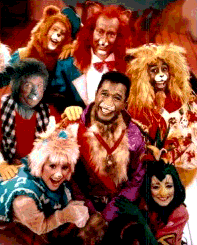
Zoobilee Zoo was a first-run syndicated children's series produced and directed by Steve Binder, developed by Hallmark with DIC Enterprises, and hosted by Ben Vereen as Mayor Ben, a leopard. It premiered in September 1986, ran 65 original episodes, and last aired March 27, 1987. It won the 1987 Daytime Emmy for Outstanding Costume Design. Hallmark financed it to win awards, and Binder says it did, but the show never got merchandise and never became the franchise he thought it could be.
A show commissioned to win prizes
The origin is unusually blunt, and it comes from the man who ran the production. Binder, who produced and directed all 65 episodes of the original series, told Mental Floss in 2016 that Hallmark's entertainment division conceived the show for one reason: to win awards. "That was their number one focus," Binder said. "And we did."
The project began as a joint venture between Hallmark and Mattel. Mattel left, and DIC Enterprises came in as the children's distributor. The corporate ambition was stated plainly at the time. Jim McDowell, Hallmark's director of marketing services, told the Los Angeles Times in December 1986 that the company had public-relations considerations in mind, hoping to make a TV product as worthy for children as Hallmark Hall of Fame had been for adults. The same piece put the investment at nearly $10 million from Hallmark and its partners, and McDowell did not pretend to know when it would come back. "How long is it going to take to get our investment back? I still don't know the answer to that question," he said.
He was equally clear that goodwill had a floor under it. "Sooner or later, the show will live or die on its ratings and audience share."
The fight over the faces
The first real production decision was about how the animals would look, and Binder lost his patience with the answer he was handed. "When I got to Hallmark headquarters in Kansas City, the characters looked like theme park people," he told Mental Floss. "I thought they needed to have expressions."
He lobbied for make-up and prosthetics instead of sports-mascot costumes, and got them. That single call is the reason the show reads on camera as performers rather than as walk-around suits, and it is also, directly, the reason for the only major award the show ever won: the 1987 Daytime Emmy for Outstanding Costume Design.
Back in Los Angeles, Binder cast for theatrical chops, actors who could sing, dance, and memorize hundreds of pages. For the host he went to someone he already knew. "I had had a relationship with him for years and asked him to be the mayor," he said of Ben Vereen. Vereen played a feisty leopard who served as the mayor of Zoobilee Zoo and appeared intermittently through each half-hour to introduce or comment on the story, or to perform a quick song and dance. His co-stars were Karen Hartman, Forrest Gardner, Louise Vallance, Sandey Grinn, Gary Schwartz and Michael Moynahan.
Vereen was only around for a few weeks. The rest of the cast, Binder said, "had no social life" for the duration of the shoot. "It was like doing a Broadway show every day."
Dennis Rosenblatt, who directed more episodes of the show than anyone else, described on the show's own podcast in 2024 how the Vereen material was physically separated from everything else. "Ben was on a different stage, a smaller soundstage," he said, and Binder handled those segments personally. "That was the easiest part of the show for me. The reason it was so easy was because Steve Binder directed all the scenes." The reasons were practical and financial at once: "there wasn't room for Ben's set on the main stage," and the two units frequently had to shoot at the same time.
Five shows a week, and ninety cuts to make them in
The production schedule is where the story stops being a charming preschool show and starts being an endurance record. Rosenblatt is unambiguous about it.
"Nobody shoots five scripted shows a week," he said in 2024. "Nobody did before we did this show. Nobody did after we shot this show." He is not romantic about why it was possible. "If you brought in a lot of experienced people, they would have just told you to take the show and stuff it because it can't be done." Then: "And they were right. It can't be done." They did it anyway.
Mike Sears, a production coordinator on the show who also wrote the episode "Job Hunting," described the same week from the other side in a 2022 podcast episode. The company did a table read on Monday morning, rehearsed and camera-blocked Monday and Tuesday, and then, as he put it, "we shot five episodes in three days." The next week's five scripts arrived on Friday.
The post-production constraint is the detail that explains the show's visual style better than any aesthetic argument could. Rosenblatt says the line producer came to him right before shooting began with a problem: "We don't have enough money for editing." She went to the editors and asked how many edits they could make in three hours, which was the time budgeted to cut each episode. They came back with a number. "They said maybe 90 cuts." The instruction that followed was, in his telling, exactly that literal: "So you have to design the show so that you can do it in 90 cuts... because that's all the time we have for post."
His solution was to shoot the show so it barely needed cutting at all. "I would do what's called a line cut... I would cut the cameras live so that editing was minimized." He came to set pre-blocked, and the cast learned to find the light and to line up in a V so scenes could be cross-shot. He notes that the show's other director worked the opposite way, staging through discovery on the floor and leaving the cuts to be made in post.
The slot problem, and the station that fixed it
For a daily strip aimed at preschoolers, the entire business rests on what time it airs, and Zoobilee Zoo started badly in the one market its producers cared most about. In Los Angeles, KTTV Channel 11 launched it in September 1986 at 6 a.m. The distributor moved quickly, and on December 1 the show went to KTLA Channel 5, which put it Mondays through Fridays at 7 a.m.
Binder, speaking to the Los Angeles Times three weeks after that move, treated the fix as the whole ballgame. "If we can make it happen here, we can make it happen anywhere," he said, and: "Now we're in a good time slot on a big station. This is the test."
It was running on about 60 stations at that point, which the paper noted was not enough to attract serious national advertising. McDowell agreed the show needed help: "There's no question that we need a showcase or two."
Sears, without prompting and 36 years later, recalled the same sequence: "we were syndicated throughout the country when we first went on the air and in LA, we were on Fox and then we went to KTLA... it was on local stations all around the country." KTTV was the Fox station. A production coordinator's unaided memory landing on the same two call letters as a newspaper account written while it was happening is the strongest verification in this entire story.
The endorsement, and the reason it backfired
Peggy Charren founded Action for Children's Television and spent her career attacking programs that were really toy commercials. She almost never endorsed a specific show. The producers flew her to Los Angeles, and she made an exception, telling reporters that her organization does not usually endorse programs, "but you can't hide your head in the sand when you have goals to reach."
Her stated reasons, as recorded in the Los Angeles Times, were a checklist of everything the era's kids TV was not: the show was not based on a toy, it aimed at a narrow age group instead of everyone, it used real people rather than cartoon characters, its host was not white, it aired daily, "which is the way children watch TV," and it built stories around subjects like poetry and living with a disability. The National Education Association, the American Federation of Teachers, and the National Association of Elementary School Principals all lined up behind it too.
And that is the trap. A show with no toy line has no toy line, which means no shelf presence, no aisle reminder, and no second revenue stream to survive thin ratings on. Binder saw it happening in his own parent company's stores. "I think we developed a tremendous cult following," he told Mental Floss. "The cast would go to different libraries and perform in character. But when I'd walk into a Hallmark store, there wouldn't be any merchandise. I found it so odd."
His verdict on the missed scale is the most quoted line he has ever given about the show. "This was pre-Barney, and we basically had six Barneys," he said. "I once had someone offer to build an entire theme park. Hallmark turned them down. I never understood it."
Who was in the beaver suit
The archival cast record carries a change that most viewers never registered. Michael Sheehan played the original Bill Der Beaver in two episodes, then was replaced by Sandey Grinn, who played the role in every other episode. The record says Sheehan decided to leave the show for other interests, among them Jem.
The show's own podcast tells it as a firing, and tells it warmly. Sears recounts being with Binder when the actor came to them about the suit. "And he listened very, you know, very kindly as this guy told us all the reasons the tail was hurting his back and it had to be changed," Sears said. "It was just like a five minute dissertation about the discomfort this outfit was causing." Binder's answer, in Sears' account: "And Steve put his hand on his back and said, 'listen, the primary concern of ours as an executive producer is your safety and comfort. So we're going to let you go and we'll have somebody else in the suit tomorrow.'" Somebody else was in the suit the next day.
The two accounts describe the same exit and disagree about who ended it. This page does not pick one. The episode also carries the softer reading, that the man was mostly a voiceover actor, that the job was not what he wanted, and that he has no regrets about leaving, which is a claim only the people who stayed in touch with him can make.
How the telling has grown over the decades
- December 31, 1986, Los Angeles Times. Lee Margulies' piece is the contemporaneous primary and the spine of everything above. Binder and McDowell speak while the outcome is still unknown: the $10 million figure, the roughly 60 stations, the KTTV to KTLA move on December 1, the award-bait motive stated as public relations, and Charren's six reasons in her own words. Nothing here is reconstructed from memory, because none of it had happened yet.
- May 19, 2016, Mental Floss. Jake Rossen gets Binder thirty years on. This is where the origin becomes explicit ("to win awards"), where the prosthetics fight is recorded, and where the merchandise complaint and the six-Barneys line enter the record. It also compresses the Los Angeles story: it describes only a 6 a.m. slot quickly changed to 7 a.m., losing the station move entirely.
- December 1, 2022, the show's podcast. Mike Sears adds the production-office view: the Monday table read, five episodes shot in three days, scripts arriving a week ahead, and the beaver-suit departure told as a firing rather than a resignation. He also independently confirms the 1986 newspaper's Fox-then-KTLA sequence.
- September 30, 2024, the show's podcast. Dennis Rosenblatt supplies the making of it as craft: five scripted shows a week, the 90-cut edit ceiling, the live line cut, the pre-blocked V staging, and the fact that Binder shot all of Vereen's material himself on a separate stage.
Where the tellings do not agree, and this page will not reconcile them. The archival record gives a premiere of September 15, 1986; Mental Floss gives September 22, 1986. No listing was reachable to settle the day, so this page says September 1986, which the Los Angeles Times independently supports by writing in December that KTTV "introduced it last September." The shoot dates split too: Mental Floss says the 65 episodes were completed in the spring and summer of 1985, while the 1986 Los Angeles Times, writing at the end of that year, says the show was "shot here last summer," meaning 1986. Where the show landed in 1992 splits as well: Mental Floss says the Disney Channel, while the archival record says The Learning Channel picked it up for its Ready Set Learn preschool block, citing a Los Angeles Times piece from December 27, 1992. Contemporaneous reporting beats a recollection thirty years later every time, and the disagreements are left visible rather than averaged.
The honest bottom line
Zoobilee Zoo was a corporate prestige project, and its producer says so out loud: a greeting-card company wanted an award, funded a show to get one, and got one. The economics under it were brutal in a way the finished product hides, five scripted half-hours a week cut to a ninety-edit ceiling, and the reason the show looks stagey in places is that the director was shooting to a post-production budget rather than to a style. It never found a real audience because it aired at dawn on whatever station would take it, and the very quality that earned it Peggy Charren's rare endorsement, having nothing to sell, removed the merchandising engine that kept its competitors visible. What survives is the thing money could not buy: adults performing at full commitment in prosthetic animal faces on a daily children's show, taking preschoolers seriously enough to build episodes around poetry and disability, in a decade when most of the schedule was a toy catalog with a plot. Reading Rainbow was the other show of the decade that survived on earnestness instead of merchandise, funded by grants instead of toy sales, and watched by children who could tell the difference.
Sources
- Los Angeles Times, "'ZOO'--WILL IT PASS SYNDICATION TEST?", Lee Margulies, December 31, 1986 (contemporaneous primary: Binder, Jim McDowell, Peggy Charren, station and investment figures).
- Mental Floss, "The Lost Magic of Zoobilee Zoo", Jake Rossen, May 19, 2016 (Steve Binder retrospective).
- Zoobilee Zoo: The Podcast, "Episode 28 - Job Hunting w/ Writer Mike Sears", originally published December 1, 2022.
- Zoobilee Zoo: The Podcast, "Director Dennis Rosenblatt Bonus", originally published September 30, 2024.
- Television Academy Foundation, The Interviews, Steve Binder oral history, recorded March 4, 2004 (checked; contains no Zoobilee Zoo material).
- Wikipedia, "Zoobilee Zoo" (run dates, episode count, cast record, Emmy, and syndication history, cross-checked).
Zoobilee Zoo is closer than you think, one cushion away. More show stories live at /full-story/. Related: the full story of Pee-wee's Playhouse, Steve Binder's other 1986 show, and the full story of Fraggle Rock.

Frequently asked
What was Zoobilee Zoo?
A first-run syndicated children's series about six anthropomorphic animals, each with an artistic skill, living in a place called Zoobilee Zoo. It was aimed at preschoolers, ran 65 original half-hour episodes, and was developed by Hallmark with DIC Enterprises.
Was Ben Vereen really on Zoobilee Zoo?
Yes. Vereen played Mayor Ben, a leopard, appearing in wraparound segments through each half-hour to introduce the story or perform a song and dance. Steve Binder, who knew him for years, asked him to take the part, and Binder personally directed all of Vereen's scenes on a separate soundstage.
When did Zoobilee Zoo come out?
It premiered in September 1986 and its original run ended March 27, 1987. Sources disagree on the exact premiere day, September 15 or September 22, so this page states the month.
Why did Zoobilee Zoo get cancelled?
It made 65 episodes, ran on about 60 stations, and could not draw enough national advertising to justify more at that scale. In Los Angeles it launched at 6 a.m. before moving to a 7 a.m. slot on KTLA, and it spent its life in early-morning hours on whatever local stations carried it. It continued in reruns for years afterward and returned for direct-to-video episodes in 2000.
Why was there never any Zoobilee Zoo merchandise?
Nobody involved has ever explained it. Binder says he would walk into Hallmark stores, the parent company's own shelves, and find nothing there, and that an offer to build a Zoobilee Zoo theme park was turned down. The absence of a toy line is exactly what won the show its endorsement from Action for Children's Television, and it is also what left the show with no presence outside its timeslot.
Who played Bill Der Beaver?
Sandey Grinn played Bill Der Beaver in all but two episodes. Michael Sheehan originated the role and left after two. The archival record says he left for other interests including Jem, and the show's own podcast tells it as Binder releasing him on the spot after a complaint about the costume's tail.