The Full Story of Disney's Adventures of the Gummi Bears
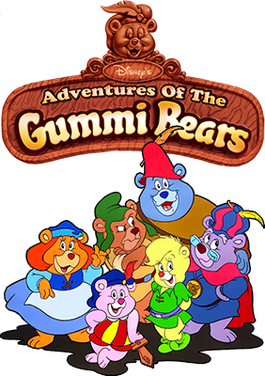
A new studio boss pointed across his living room at a man who had never worked in television and told him to make a cartoon out of a candy. Everyone in the room thought he was joking, or crazy, and the first draft had a villain named Licorice Whip. What came out the other end was a lavishly animated medieval fantasy that dragged the entire Saturday-morning business up to a new standard, and it was the first cartoon Disney ever made for television.
Adventures of the Gummi Bears premiered on NBC on September 14, 1985, and ran 65 episodes across six seasons through 1991, moving from NBC to ABC to the syndicated Disney Afternoon. It was created by Jymn Magon at the brand-new Walt Disney Television Animation, born when Disney CEO Michael Eisner told Magon, a total unknown, to build a show around gummy candy his kids loved. Magon turned a literal candy show into a Tolkien-inflected fantasy epic, and it, alongside The Wuzzles, launched Disney's television animation division and raised the bar for the medium.
"Make me a show about that"
When Michael Eisner arrived from Paramount to run Disney in 1984, he wanted a television animation division the studio had never bothered to build, and he liked to start with people rather than pitches. Gary Krisel, the young head of the Disney Music Company, was invited to Eisner's Beverly Hills home one Sunday morning, his only free time so soon after taking over, and brought along Jymn Magon, a record producer who had spent eight years making Disney albums and had never worked in TV. Magon has told the next part many times and still sounds amazed by it. "I've told this story numerous times, and I still can't believe it happened this way," he said in a 2017 interview with Rediscover the '80s.
Six or eight "creative types" kicked ideas around, and then Eisner mentioned that his kids had eaten a great new candy at summer camp, gummi bears. "Then he turned to me, a total unknown," Magon recalled, "and said, 'Make me a show about that.'"
The room's reaction was not confidence. "Afterward we all thought Eisner was crazy," Magon said. "Who the heck makes a show about characters that get eaten? So it sat fallow for a couple weeks until I got a phone call: 'Where's my show?' It was Eisner."
From Licorice Whip to Tolkien
Told to invent a show from a candy name, Magon started exactly where the assignment pointed, and it was a disaster. "I quickly started typing up some ideas about a candy-centric world," he said. "The villain was Licorice Whip, and his sidekick was Scummi Gummi. Yes, it's sadly true." Then the concept escaped the candy aisle. "Fortunately, that slowly gave way to sanity, and we started thinking of the classic Disney movies like Snow White and the Seven Dwarfs and Sleeping Beauty," Magon said. "These were set in a European, medieval, fantasy world. That seemed like a safe route to go, because we had never made a TV show before, and so castles and knights crept into the development."
The result bore almost no resemblance to a candy commercial. The finished Gummi Bears live in a hidden warren called Gummi Glen, remnants of a once-great civilization driven into hiding by humans, guarding old magic and technology and defending the kingdom of Dunwyn against the ogre-backed Duke Igthorn. Magon has been open about where the ambition came from. Beyond the Disney classics, he said, "I used my love of Tolkien's work as inspiration," and his co-creator Art Vitello "introduced me to Hayao Miyazaki and Vicente Segrelles," influences visible in the show's look. What began as a joke about edible characters ended as high fantasy.
Building a studio from nothing
The hard part was not the story; it was that the studio making it did not yet exist. "You must remember, we were a brand new division, so there was nothing in place," Magon said. "We had to build the structure and the work force for the department from scratch. So finding a strong team was the biggest obstacle." Vitello assembled the first core group of artists, and Magon credits them with inventing a house style on the spot. "Art did a fantastic job pulling together that first core group of artists," he said, naming Thom Enriquez, Hank Tucker, Rob Laduca, Ed Wexler and Gary Eggleston. "I think they really set the tone of what a 'Disney TV Animation' show looks like."
Magon's own job was invented on the spot too. When Disney sold the show to NBC, he recalled, "the head of their children's programming said, 'OK, so who's going to be your Story Editor?' ... My boss Gary Krisel pointed to me and said, 'We thought Jymn would do that.'" So a man who had produced records for eight years became the story editor of Disney's first television cartoon, teaching himself to structure eleven- and twenty-two-minute episodes as he went. "I was co-creator and story editor," he said. "Art and I were the key players." In his 2014 Full Circle Magazine conversation he described the strangeness of the early days plainly: at one point, he said, he was "the only 'creative' person in the entire department," still doubling as a record producer for the Music Company.
The bar it raised
Gummi Bears mattered beyond its own run because of what it was: not an adaptation, not a toy tie-in, but a series conjured, as Magon put it in 2014, from "nothing more than the name for a candy," making it "the first Disney animated series that was created out of whole cloth." Disney was walking into a business owned by cheaper, faster studios, and Magon knew it. "We all knew we were stepping into an arena that was dominated by studios like Hanna-Barbera, Filmation, and such," he said. "As it turned out, we ended up raising the bar for what Saturday Morning shows looked like."
That is not just the creator's pride talking. The show was lavishly budgeted by the standards of 1985 television, and it is widely credited with beginning an era of artistic improvement in TV animation, one that pressured competitors to raise their own standards to avoid unflattering comparison. Magon has said the same thing more warmly. "Gummi Bears not only set the tone for our other shows, it set the bar for the entire TV toon business," he told Full Circle. "Other studios sat up and took notice." Asked to name a favorite among the shows he built, he keeps a place for this one: "Gummi Bears will always be my firstborn."
How the telling has grown over the decades
- 2014, Full Circle Magazine. Jymn Magon frames Gummi Bears as the studio's founding act, "created out of whole cloth" from a candy name, and describes being nearly the department's only creative person while still producing records.
- Kevin Johnson interview. Magon fills in the corporate backdrop: Eisner arriving from Paramount, where he had run ABC children's programming and developed a taste for TV animation, and the tiny founding department of a few executives and one writer who had never worked in television.
- 2015, Cartoon Brew. The 30th-anniversary appraisal fixes the show's significance in the record, that Gummi Bears and The Wuzzles were the first series Disney Television Animation ever made, and that Gummi Bears helped start a wave of artistic improvement across the medium.
- 2017, Rediscover the '80s. Magon gives the fullest firsthand account of the origin: the Sunday meeting at Eisner's home, the "make me a show about that" moment, the Licorice Whip false start, and the pivot to Tolkien and medieval fantasy.
The drift is in the origin's small details. The version that circulates most widely, as Cartoon Brew tells it, is that Eisner "was inspired to develop the series after one of his boys requested the candy," a store-counter anecdote, and that he was invested enough to personally sell it to NBC. Magon, who was in the room, remembers it as kids returning from summer camp raving about gummi bears, and Eisner pointing at him across a living room. The through-line is identical, Eisner's children, the candy, the whim, but whether the spark was a request at a store or a report from camp is exactly the kind of detail that softens and shifts as a founding story gets retold. What nobody disputes is that a billion-dollar animation division began with a snack.
The honest bottom line
Gummi Bears started as one of the more cynical-sounding ideas in television history: a powerful executive ordering a cartoon named after a candy his kids liked, handed to a record producer with no TV experience, at a studio that did not exist yet. By every rule of the era it should have been disposable. Instead the people making it treated a candy joke as a chance to prove Disney could do television animation without embarrassing its own name, reached past the assignment to Tolkien and Miyazaki and the studio's own fairy-tale classics, and built a medieval fantasy handsome enough to shame the competition into spending more. The whim was real. So was the ambition that refused to take the whim literally. The Care Bears had already proved that animation done at a higher standard than the industry expected could dominate a market built on cutting corners, and the Gummi Bears were Disney's answer to the same question.
Sources
- Wikipedia, "Adventures of the Gummi Bears" (premiere and finale dates, network history, episode count, and the show's fantasy setting; cross-checked).
- Rediscover the '80s, "Interview with Jymn Magon, Writer/Producer for Disney's DuckTales", 2017 (the Eisner meeting, "make me a show about that," the Licorice Whip false start, and the Tolkien pivot).
- Full Circle Magazine, "A Conversation with Jymn Magon", 2014 ("out of whole cloth," the one-person department, and raising the bar for TV animation).
- Kevin Johnson (kevinjohnsonstuff.com), interview with Jymn Magon (Eisner's background and the founding of the department).
- Cartoon Brew, "Disney's Adventures of the Gummi Bears Turns 30 Years Old Today", Amid Amidi, September 14, 2015 (the widely-told candy-request origin and the show's place as one of Disney Television Animation's first two series).
Bounce back to the room with the morning glow whenever, the theme song is waiting. More show stories live at /full-story/. Related: the full story of DuckTales and the complete Saturday morning lineup of fall 1985.
Frequently asked
How did the Gummi Bears cartoon start?
Disney CEO Michael Eisner wanted to launch a television animation division and, at a 1984 meeting, told record producer Jymn Magon to build a show around gummy candy his children loved. Magon developed it into a medieval fantasy series, and it premiered on NBC on September 14, 1985.
Was Gummi Bears based on a toy or a comic?
Neither. Unlike most cartoons of its era, it was invented from scratch. Magon has called it "the first Disney animated series that was created out of whole cloth," built only from the name of a candy.
Who created Adventures of the Gummi Bears?
Jymn Magon created and story-edited it, with producer and director Art Vitello as his key partner. Both were part of the brand-new Walt Disney Television Animation division.
Why is Gummi Bears set in a medieval fantasy world?
The first concept was a literal candy world with a villain named Licorice Whip, which Magon abandoned. He rebuilt it around Disney's fairy-tale classics and his own love of Tolkien, so castles, knights and magic replaced the candy premise.
Was Gummi Bears really Disney's first TV cartoon?
Yes. Gummi Bears and The Wuzzles, both launched in 1985, were the first series produced by Disney Television Animation, the division that would go on to make DuckTales, Chip 'n Dale: Rescue Rangers and the rest of The Disney Afternoon.
How long did Gummi Bears run?
It ran 65 episodes across six seasons, from its NBC premiere on September 14, 1985, through moves to ABC and then the syndicated Disney Afternoon block, ending in 1991.