The Man Who Beat Press Your Luck · The Full Michael Larson Story
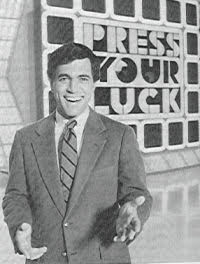
An unemployed ice cream truck driver from Ohio sat down at a game show board that was supposed to be random, hit the same two squares 29 times in a row, and walked out with more money than any daytime contestant in American history. The control booth called the head of CBS daytime mid-taping. The network spent days hunting for the cheat, could not find one, and paid him anyway. Fifteen years later he died in hiding, running from a fraud investigation.
Michael Larson taped his Press Your Luck appearance on May 19, 1984, and won $110,237 in cash and prizes over 47 spins. The Big Board's "random" lights actually ran on only five repeating patterns, which Larson had memorized off videotape. CBS found no rule broken and paid. The episode aired in two parts on June 8 and 11, 1984. Larson died in 1999 in Apopka, Florida.
The board was never random
Press Your Luck's Big Board was a ring of 18 squares that lit up in what looked like an unpredictable scramble until the contestant hit a button. Land on cash, keep going. Land on a Whammy, lose everything.
It was not unpredictable. The sequence ran on five patterns, and two squares, four and eight, always carried cash plus an extra spin. A contestant who could recognize which pattern was running and time a button press to those squares could, in theory, play forever without ever risking anything.
Larson worked that out at home in Lebanon, Ohio, off recordings of the show. Then he flew to Los Angeles, auditioned in person at the studio, and got on.
What the tape shows
The first half went badly on purpose or by accident, depending on how you read it. Larson hit a Whammy on his very first spin, which cost him but let him calibrate the timing of his presses. He went to the second half in last place with $2,500, behind Ed Long and Janie Litras.
Then he stopped missing. Over his first 15 spins of the second round he occasionally slipped off his safe squares but avoided every Whammy, banking $29,351. Beginning with spin 16, he landed on squares four and eight for 29 consecutive spins, adding $102,851 in cash and prizes. Every one of those spins gave him another spin, so the turn simply would not end.
The run stopped because he got tired. Larson described the moment to TV Guide a decade later, in Peter S. Greenberg's November 1994 account.
"I remember that moment. I was just so drained, [...] I suddenly forgot where the Whammies were. So I stopped and passed control of the board to the other players. I felt so relieved that it was over."
By the end, after 47 total spins and a stretch where Litras passed spins back to him that the rules obliged him to take, Larson had $110,237 in cash and prizes, including a sailboat and vacations to Kauai and the Bahamas. Ed Long kept the $11,516 he had won on the previous episode. Janie Litras went home with consolation prizes.
The phone call from the control booth
The people running the show knew something was wrong while it was happening. The control-booth operators called Michael Brockman, who ran daytime programming for CBS.
Brockman's description, also given to TV Guide in 1994, is the best surviving account of the room: "Something was very wrong [...] Here was this guy from nowhere, and he was hitting the bonus box every time. It was bedlam, I can tell you."
The producers wanted to stop the taping. They could not find a rule he was breaking, so it kept going.
Afterward CBS pored over the footage looking for the fix, and there was not one. Brockman has described the network's reasoning in the years since: "What was illegal about the process? He beat the system. So, how do you deny him the monies that he earned? What legal basis do you have to do that?" The decision followed. "And after some discussion, it was agreed that he could receive the money that he won."
Bob Boden, another former CBS Daytime executive, put the internal verdict plainly in 2007. The network's "prevailing wisdom [...] was that he hadn't cheated; that he was just smarter than CBS."
A few weeks later they mailed him a check.
What the network did next
CBS did not want it to happen twice. The Big Board was reprogrammed with 27 additional light patterns, and the network imposed a $75,000 cap on contestant winnings. Some executives wanted the episodes shelved permanently, and the decision was made that they should never air again, a requirement written into the show's syndication contracts. They have since run repeatedly on Game Show Network and Buzzr.
Larson's response was to ask for a rematch. He contacted the show's contestant coordinator with a challenge that went unanswered: "I know you've added patterns to the board, but I bet I can beat you again. How about a tournament of champions?"
The part that is not a heist movie
The temptation is to file this as a caper with a happy ending. The people who knew Larson do not tell it that way.
His brother James described a man who had been running schemes since childhood, selling marked-up candy bars to middle schoolers, opening and closing bank accounts under assumed names to collect new-customer bonuses, once registering a business under a relative's name so he could fire himself and claim unemployment.
"He didn't understand the value of good, honest hard work, and just go and do your job and get your pay," James told This American Life in 2010.
The winnings did not last. Larson lost much of the money, and in 1995 he fled a law-enforcement investigation into a fraudulent multi-level marketing scheme. He died in hiding in 1999, in Apopka, Florida.
The board he beat was the one honest piece of work in the story, and it is the only part anyone remembers.
How the telling has grown over the decades
- November 26, 1994, TV Guide. Peter S. Greenberg's "The Day the Game Show Got Whammied" is the foundational account and the only one containing Larson's own voice at length, including his explanation that he stopped because he was drained and had lost track of the Whammies. Brockman's "It was bedlam" line comes from the same piece. Larson also appeared on Good Morning America that year, tied to the release of Quiz Show, to talk about what he had done.
- March 16, 2003, Game Show Network. "Big Bucks: The Press Your Luck Scandal" airs as a two-hour documentary built around the episodes themselves, hosted and narrated by original host Peter Tomarken. It is the first time most of the audience sees the run. The broadcast was dedicated to producer Bill Carruthers, who had died two weeks earlier.
- 2007. Former CBS Daytime executive Bob Boden gives the network's retrospective verdict: not a cheat, just smarter than CBS.
- 2010, This American Life. Larson's brother James supplies the biographical frame that the game-show tellings leave out, describing a lifelong pattern of schemes and a man who considered ordinary work a mistake.
- 2024, The Luckiest Man in America. Paul Walter Hauser plays Larson in a dramatized feature, four decades after the taping, alongside a second GSN documentary, a Spanish-language graphic novel, and a long run of podcast retellings.
The participants do not really contradict each other on the facts, which is unusual for a story this often retold. What shifts is the verdict. In 1994 the framing was scandal, a system beaten and a network embarrassed. By 2003 the tone had turned admiring, with the network's own channel airing the run as an event. Boden's 2007 line completes the reversal: the man CBS once accused of cheating is now credited with being smarter than the people who built the game. The one voice that never softened is the family's. James Larson's account is the only telling in which his brother is not a folk hero.
The honest bottom line
Michael Larson did not break a rule, hack a machine, or bribe anyone. He watched a television show closely enough to notice that its randomness was a lie, memorized five patterns, and then executed under studio lights for 47 spins without losing his nerve until fatigue finally took him. That is a genuine feat, and CBS's own executives concluded as much. It is also true that he was a career schemer who lost the money, ran from a fraud investigation, and died in hiding at 49. Both things are the same story. The board really was beatable, and the man who proved it was never going to be satisfied with a fair game.
Sources
- TV Guide, "The Day the Game Show Got Whammied", Peter S. Greenberg, November 26, 1994, volume 42 number 48, pages 26 to 29 (Larson's own account of spin 45 and Michael Brockman's account of the control booth).
- Biography.com, Michael Larson feature (Brockman on why CBS paid; James Larson's characterization of his brother, quoted from This American Life, 2010).
- Game Show Network, "Big Bucks: The Press Your Luck Scandal", two-hour documentary hosted and narrated by Peter Tomarken, first aired March 16, 2003, dedicated to producer Bill Carruthers.
- Bob Boden, former CBS Daytime executive, 2007, on the network's prevailing wisdom. No outlet or URL is pinned for this remark in the record; it is named as attribution only and is not linked.
- Wikipedia, "Press Your Luck scandal" (taping and broadcast dates, spin-by-spin totals, the five patterns, the 27 added patterns and $75,000 cap, other contestants' winnings, and Larson's death, cross-checked against the cited TV Guide and documentary record).
No whammies on the big comfy couch. More show stories live at /full-story/. Related: the full story of Remote Control and the full story of Double Dare. BobbyAndJason.com covers the show in Press Your Luck: 'No Whammies!' and the 80s Game Show Heist.

Frequently asked
How did Michael Larson beat Press Your Luck?
He recorded the show and worked out that the Big Board's supposedly random lights ran on only five repeating patterns. Squares four and eight always carried cash plus an extra spin, so once he could recognize the pattern and time his press, his turn never had to end.
How much did Michael Larson win?
$110,237 in cash and prizes over 47 spins, including a sailboat and trips to Kauai and the Bahamas. It was the largest single-day daytime game show win in the world at the time.
Did CBS make him give the money back?
No. The network searched the footage for evidence of cheating, found none, and concluded he had broken no rule. Michael Brockman, who ran CBS daytime, recalled the reasoning as "What was illegal about the process? He beat the system." A check was mailed a few weeks later.
When did the Michael Larson episode air?
It was taped May 19, 1984 and broadcast in two parts on June 8 and 11, 1984, because the game ran too long for a single episode.
What happened to Michael Larson?
He lost much of the money, and in 1995 fled an investigation into a fraudulent multi-level marketing scheme. He died in hiding in 1999 in Apopka, Florida.
Can it still be done?
No. CBS reprogrammed the Big Board with 27 additional light patterns and capped contestant winnings at $75,000. Larson offered to beat the new board in a tournament of champions and was never answered.