The Full Story of the Smurfs on NBC
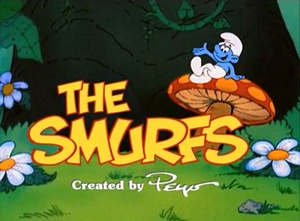
NBC had already turned down a Smurfs cartoon once. Then the network's president bought his daughter a little blue doll in a Colorado ski town, changed his mind, and handed Hanna-Barbera a full hour of Saturday morning for characters a Belgian cartoonist had invented to say a nonsense word. The show that resulted dragged a last-place network to number one and stayed there most of the decade.
The Smurfs premiered on NBC on September 12, 1981, and ran nine seasons and 256 episodes through December 2, 1989. It happened because NBC president Fred Silverman bought his daughter Melissa a Smurf doll in a toy shop in Aspen, Colorado, and decided the characters could anchor Saturday morning, reversing an earlier NBC rejection. Produced by Hanna-Barbera under the close supervision of Belgian creator Peyo, it debuted in a rare hour-long slot, pulled a 44 share, and lifted NBC from third place to the top-rated network.
The doll that overruled the network
The Smurfs, or les Schtroumpfs, were created in 1957 by the Belgian cartoonist Peyo, Pierre Culliford, and were a merchandising phenomenon across Europe long before America noticed them. The characters reached the United States around 1979 through Wallace Berrie and Company, whose Smurf figurines and dolls sold hugely. One of those dolls is the reason there was ever a cartoon. As Joe Barbera recounts in his autobiography My Life in 'Toons', NBC president Fred Silverman bought his daughter Melissa a Smurf doll at a toy shop while the family was visiting Aspen, Colorado, and came away thinking the little blue creatures might make a good Saturday-morning series.
What that famous story usually leaves out is that NBC had already rejected a Smurfs proposal before the doll changed the president's mind. Silverman contacted Barbera, charged Hanna-Barbera with acquiring the rights, and guaranteed an on-air commitment if the studio could build a series around the comics. A show the network had passed on became a mandate because the boss's kid got the toy.
Barbera's fight for the hour
Getting the show made meant getting it room, and Joe Barbera has said the size of the order was itself a battle. Talking to the press in 1982, he framed the Smurfs as a break from a genre nobody had wanted to buy. "For a long time you couldn't give fantasy away," Barbera said. "I had to fight to get them to give us an hour." An hour was extraordinary; most cartoons ran a half hour, and the Smurfs launched at sixty minutes and would later expand to ninety.
Barbera was also determined that the adaptation carry more weight than its cuteness suggested. "Even though they're a happy little group of Smurfs, they have problems too. That's what life is all about," he said in 1982. "The days of showing little elves playing around a mushroom are gone forever." He described the studio's job as translation rather than invention: "Our job as adaptors has been to preserve the qualities that make Peyo's Smurfs so special, while also using our abilities and experience to allow the animated Smurfs to stand on their own as cartoon stars."
Peyo in the room
The preservation was not a slogan. Peyo supervised the adaptation closely, held regular meetings with Hanna-Barbera in Europe, visited the Burbank studio several times a year, and had veto power over any storyline, character design or drawing he disliked. That authority produced friction early. Peyo would examine a frame of film and object that a drawing was wrong and out of proportion, and the studio had to explain a fundamental of American animation to the man who drew the characters: that the Smurfs would stretch and squash within single drawings, and that the distortion was what made the movement look alive. Peyo worked through an interpreter, and the show he was policing was being run day to day by producer and story editor Gerard Baldwin, with Peyo, Baldwin, Yvan Delporte, Len Janson and Chuck Menville among the key early writers. Don Messick voiced Papa Smurf; Paul Winchell voiced Gargamel.
The most persistent myth about the show belongs to this section, and it is worth correcting. Because Peyo's Smurf world was almost entirely male, the television series introduced Smurfette in a story where the villain Gargamel builds a fake female Smurf to lure the others, and Papa Smurf's magic turns her from a scheming creation into the friendly Smurfette. It is often assumed Hanna-Barbera invented her. They did not. Peyo created Smurfette in the comics in 1966, using nearly the same Gargamel origin, and the studio's first Smurfette episode was adapted directly from his story. The cartoon popularized her as a permanent regular, but it did not invent her.
Number three to number one
The show worked immediately and enormously. It debuted as an hour on September 12, 1981, and became the top-rated program on Saturday morning almost at once. At its peak it drew a 44 share, meaning 44 of every 100 television sets in use were tuned to it, and that number did more than sell toys. It took NBC from third place to the top-rated network for the year, and it cancelled the network's own plans to scrap Saturday cartoons in favor of a weekend edition of the Today show. NBC held the Saturday-morning crown for most of the rest of the decade on the strength of the Smurfs, which is a remarkable thing to say about a Silverman initiative. Fred Silverman had been a programming genius at CBS and ABC and then presided over a famously grim stretch at NBC, and the Smurfs were one of the very few unambiguous hits to come out of it. NBC sold them accordingly, billing the show as "The 'biggest' little sensations since Charlie Brown!"
The show ran until it strained. By 1989 it was in a ninth season past 200 episodes, an almost unheard-of length when most cartoons vanished after two seasons, and to keep it fresh NBC pulled the Smurfs out of their village entirely and sent them tumbling through time, a lost-in-history format that arrived just as the network's prime-time hit Quantum Leap was doing the same thing. The last original episode aired December 2, 1989, and NBC cancelled the Smurfs and the rest of its Saturday cartoons in April 1990 to make room for live-action programming. Around the same time, Peyo severed Hanna-Barbera's rights after the studio used the Smurfs, without his permission, in the anti-drug special Cartoon All-Stars to the Rescue. He died in December 1992. The first visible crack came a year earlier: in fall 1988 NBC trimmed the show from ninety minutes to sixty, a change the fall 1988 Saturday morning lineup records.
How the telling has grown over the decades
- 1982, the press. Joe Barbera, with the show a fresh hit, gives the contemporaneous maker's account: the fight to secure an hour, the insistence that the Smurfs have real problems, and the framing of the studio as adaptor of Peyo rather than author.
- 1994, Barbera's autobiography. My Life in 'Toons' fixes the origin in print: Silverman, the Aspen toy shop, the doll for Melissa, and the decision to build a Saturday-morning series around it.
- Ongoing trade and fan history. Later retrospectives assemble the production detail: Peyo's veto power and his early clash with the animators over proportion, Gerard Baldwin's role, the 44 share, and the correction of the Smurfette-invention myth against Peyo's 1966 comic.
Two things drift in the retellings, both worth naming. The origin story, repeated as a tidy accident, usually drops the fact that NBC had already said no once; the doll did not discover the Smurfs so much as overrule a decision the network had already made. And the Smurfette question genuinely splits, between the widespread assumption that Hanna-Barbera created her and the record that Peyo did, in 1966, with the same Gargamel scheme. The dates and the ratings are not in dispute. The credit is where the story bends.
The honest bottom line
The Smurfs was a merchandising engine wearing a cartoon, greenlit on a whim after a rejection, adapted from a European comic by a studio famous for volume over polish, and eventually stretched so far past its natural length that it had to send its characters through time to survive. All of that is true, and none of it is why it mattered. Joe Barbera fought for a full hour and used it to prove that a soft, gentle fantasy could dominate a daypart everyone assumed belonged to action and noise, and he did it while honoring a Belgian cartoonist who stood in the room correcting the drawings. A last-place network became number one because a father bought his daughter a toy. The whim was real. So was the craft underneath it. The Chipmunks proved the same model could work with an even older property: bring something beloved back, spend more on the animation than anyone expects, and watch the ratings follow the care.
Sources
- Wikipedia, "The Smurfs (1981 TV series)" (premiere and finale dates, season and episode counts, network and production facts, cross-checked).
- Joseph Barbera, My Life in 'Toons': From Flatbush to Bedrock in Under a Century, Turner Publishing, 1994 (the Silverman doll origin, pp. 184 to 187).
- Cartoon Research, "The Birth of Hanna-Barbera's Smurfs" (Barbera's 1982 quotes, Peyo's supervision and the proportion clash, the 44 share, the Smurfette correction, and NBC's rise to number one).
Smurf a while longer, the cushions are blue anyway. More show stories live at /full-story/. Related: the complete Saturday morning lineup of fall 1981 and the full story of Muppet Babies.

Frequently asked
How did the Smurfs cartoon start?
NBC president Fred Silverman bought his daughter Melissa a Smurf doll in a toy shop in Aspen, Colorado, and decided the characters could anchor Saturday morning. He had Hanna-Barbera acquire the rights, reversing an earlier NBC rejection of a Smurfs series.
When did the Smurfs air, and for how long?
The Smurfs premiered on NBC on September 12, 1981, and ran nine seasons and 256 episodes until December 2, 1989. It debuted in an unusual hour-long slot and later expanded to ninety minutes.
Who created the Smurfs?
The Belgian cartoonist Peyo, Pierre Culliford, created the Smurfs in 1957. He also served as story supervisor on the Hanna-Barbera cartoon, with veto power over designs and stories.
Did Hanna-Barbera invent Smurfette?
No. Peyo created Smurfette in the comics in 1966, with the same origin in which the villain Gargamel builds her to trap the Smurfs. The cartoon adapted his story and made her a permanent regular, but it did not invent her.
How big a hit was the Smurfs for NBC?
Enormous. At its peak it drew a 44 share, took NBC from third place to the top-rated network for the year, and cancelled the network's plan to replace Saturday cartoons with a weekend Today show. It was one of the few clear hits of Fred Silverman's NBC tenure.
Why did the Smurfs end?
By 1989 the show was in its ninth season past 200 episodes, and a time-travel format change failed to revive it. NBC cancelled its Saturday cartoons in April 1990 for live-action programming, and creator Peyo separately cut ties with Hanna-Barbera over the unauthorized use of the Smurfs in an anti-drug special.