The Full Story of Hulk Hogan's Rock 'n' Wrestling
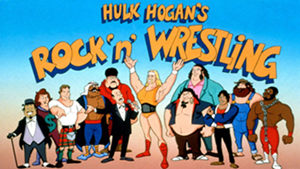
The man who made the cartoon says he got the idea by going to wrestling matches and concluding that the wrestlers were already cartoon characters who simply happened to be alive. Not one of those wrestlers voiced his own animated self, because none of them could be got into a recording studio at the same time. And the actor who spent two seasons playing Hulk Hogan never met Hulk Hogan, never heard what Hogan thought of the performance, and has said he considers that a good sign.
Hulk Hogan's Rock 'n' Wrestling aired on CBS Saturday mornings from September 14, 1985 to October 18, 1986, with reruns until June 27, 1987. It was animated and produced by DIC Animation City, developed by Jeffrey Scott, produced by Jean Chalopin and Andy Heyward, and credited to the World Wrestling Federation. It ran 26 episodes across two seasons. The wrestlers appeared in live-action segments but were voiced in animation by professional voice actors, with Brad Garrett as Hogan.
"They just happened to be live and real"
The pitch came from the cartoon side, not the wrestling side. Andy Heyward, the chairman and chief executive of DIC, was a wrestling fan who went to events, and what he saw there read to him as animation.
"It was 1983 or 1984," Heyward told WWEClassics.com in an oral history published July 22, 2013. "I was a big wrestling fan and went often to the various events. I thought the wrestlers were basically cartoon characters, they just happened to be live and real. All of those characters were so colorful. Not just Hulk, Iron Sheik, 'Rowdy' Roddy Piper, Hillbilly Jim, The Fabulous Moolah, the list goes on."
The approach was direct and the answer was quick. "I contacted Vince and proposed the idea of turning this into a cartoon series around Hulk," Heyward said. "They liked the idea and we went ahead."
What followed was not a licensing deal executed at arm's length. By Heyward's account Vince McMahon stayed in the room. "I was in constant dialogue with Vince [McMahon], who was the creative force behind everything going on," he said. "He had a lot of input and ideas on how these storyline arcs would unravel. And which characters would be the most colorful to emphasize."
Heyward's description of working with McMahon is admiring and slightly wary. "He's extraordinarily creative. He's always got great ideas and he will never cease to surprise you and do the unexpected," he said. "The one thing about Vince is, he never did anything by formula. He'd get an idea and it didn't matter how crazy it might sound, he'd lead you in a completely opposite direction than what you were expecting. And each and every one of these characters came out of his mind."
Selection was on entertainment value rather than card position. "We wanted the ones that we thought had the most entertainment value in them," Heyward said, naming Big John Studd, Junkyard Dog and Captain Lou Albano.
Why none of the wrestlers played themselves
This is the fact most people who watched the show never knew, and it has a mundane cause. The wrestlers could not be assembled.
"It was just impossible with their very busy travel schedule," Heyward said. "We couldn't get them all in a studio at one time. They were always on the road somewhere. It just was not a practical option." His read on the consequences is unbothered: "I think, by and large, nobody ever complained about it."
Jimmy Hart, who managed Hogan and others and appeared in the show's live-action segments, put the same constraint in the company's own terms. "Back then, it was so hard to get Hulk, because they had him going seven days a week," Hart said. "That's how we kept the company going."
So the animated wrestlers were played by working voice actors in Burbank. Brad Garrett, later known for Everybody Loves Raymond, got Hogan the ordinary way. "I auditioned for it. I started doing voiceovers in 1982," he said. "I was known for my deeper pipes and someone heard me doing a Hulk impression during an audition."
He was 24. The room was full of people who would matter to his career and to television generally: Pat Fraley as Hillbilly Jim, Ron Feinberg as Andre the Giant, and James Avery, later Uncle Phil on The Fresh Prince of Bel-Air, as Junkyard Dog. "These are the guys who became some of my voiceover mentors," Garrett said. "We recorded out in Burbank and it was a fun, fun, fun group."
Garrett never met the man he was playing, and said so plainly: "No, I didn't. I've never met him. I always wanted to. He really wasn't involved in the production as far the recording, or writing or any of that." Asked whether he ever learned what Hogan made of the portrayal, his answer was a joke with a real edge on it: "No idea. Hopefully it was okay, because I'm still alive."
Gene Okerlund, who did appear as himself, confirmed the distance from the other direction. "I don't think he had a lot of involvement," Okerlund said of Hogan. "That was something that was put together by the company, people like Vince, and Hulk's attorney. They put it together and he was still running a full schedule on the road. I can't see him being as involved in it even as I was."
Garrett's summary of the arrangement is the clearest statement of what this show actually was: "There was never a visitor [from WWE]. It was its own thing. I think [DIC] just paid them a big licensing fee to do it."
How a 1985 cartoon was actually recorded
Garrett's account doubles as a working description of mid-80s television animation, and he draws the contrast with the feature work he does now.
"When you do film animation, like when I do a Pixar film, everyone's recorded separately. That's the way it is for 99% of all feature animation," he said. "Television animation is done as a group. There's a lot more detail in feature animation. Scheduling is a lot tougher. They're constantly tweaking it. TV animation has got to be in the can in a week, so you get everybody together."
The economics show up in the clock: "The sessions ran anywhere between three to five hours to record your 22 minutes."
He also corrects the common assumption about the order of operations. "A lot of people think you do the voice after the animation's done, that they draw it and you match the lips. You do that if you have to, but the animators draw off of your performance. Everything emanates from the performance."
The director was Stu Rosen, and Garrett credits him with the room's looseness. "He was very original in his directing. He was very actor friendly, he let you take risks. Obviously, you have to stick pretty much to the script, because the writers are there and that's what they want. But if you came up with something or threw something in that worked, he wasn't afraid of it."
The detail he remembers about James Avery is the one worth keeping: "he always recorded without shoes."
The live-action half nobody preserves
Between the animated segments the show ran short live-action pieces with the real wrestlers, and the people who made those describe something closer to improvisation than production.
"They were actually little five-minute segments we would put in between the animation," Okerlund said. They were shot in California while he was based in New York. "It took me two or three days a week. It would require me flying from New York to LA. All of those vignettes were done in LA."
The roster passing through was substantial. Okerlund remembered working out there with Junkyard Dog, Andre the Giant, Roddy Piper, Jimmy Hart, Lou Albano and The Fabulous Moolah. And the method, in his telling, was thin: the segments "may have been formatted and written, but were really old school, fly by the seats of our pants and see what happens."
Hart's memory of shooting them is fond and unpretentious. "I was lucky enough to be part of the live action segments," he said, describing one with Terry Funk "where he was showing me how to take a rope and lasso cattle and horses and the phone kept ringing and it ended with a little joke." His verdict on the whole batch: "We did a lot of these simple things that people could relate to. They were kind of corny, but the fans liked it."
Heyward's reason for including them at all was structural. "I think they just gave a dimension of reality, connecting the cartoon to the stars."
There is one further wrinkle in the credits worth noting, because it complicates the tidy DIC-only story: Saban Productions and Columbia Pictures Television are credited alongside DIC on a 1985 special episode.
What the cartoon was actually for
Jimmy Hart is the one who states the commercial purpose without decoration, and he frames it as strategy rather than accident.
"What I thought was really great about the whole show was that Vince really had the whole kids market nailed down," Hart said. "He saw what the future was and that was taking those wrestling fans in, getting them hooked on the cartoon, letting them watch our show and then making them fans for the next 30 years."
He also ties it directly to merchandise, which is the part the show's critics were reaching for at the time: "To this day, Hulk realizes that if it hadn't been for the cartoon show along with the wrestling, he probably wouldn't have sold the merchandise that he was able to sell."
The show itself was, by the archival description, barely about wrestling. Matches were rarely referenced, and wrestling functioned mainly as a device for sorting heroes from villains, with Hogan's group of faces against a set of heels led by Roddy Piper. Heyward confirms the separation was deliberate, and it was his answer to the criticism that the cartoon could not keep up with who was a hero or a villain on the live programming that week. "We tried to make the stories independent of how the evolution of the characters was taking place on the live programming," he said. "The villains were dark villains. It was all black and white so you know who to root for."
How the telling has grown, and the gap in it
- April 24, 1985, Orlando Sentinel. A piece headlined "Wrestling Cartoon Puts Hold On Taste" appears months before the premiere, establishing that the show drew critical suspicion from the outset. It is cited in the archival record; the original text was behind a paywall and could not be read this session, so nothing is quoted from it here.
- July 22, 2013, WWEClassics.com. Zach Linder assembles the only substantial oral history of the show, and it is the source of nearly everything above. Four makers speak: Heyward on the pitch, McMahon's involvement and the casting logic; Brad Garrett on the audition, the recording method and never meeting Hogan; Gene Okerlund on the vignettes and Hogan's distance from production; Jimmy Hart on the live-action shoots and the merchandising strategy.
- June 29, 2025, reported from IMDb Pro. Garrett, promoting new work, returns to the role decades later and describes voicing Hogan as a "shredder" to his voice. It is a single remark rather than a full telling, but it is the one time this story has been revisited by a maker in a different outlet and a different era.
The honest gap is worth stating rather than disguising, because this lane's usual product is a story that has been told and retold. This one has not been. Four people told it well, in one place, on one day in 2013, and almost nothing has been added since beyond a soundbite. There is no decades-long accumulation here and no meaningful drift to trace, because there are barely two accounts to compare.
What little disagreement exists is minor and the record preserves it. Asked whether The Fabulous Moolah had replaced a planned character called Mad Maxine, Heyward said flatly, "No, I don't recall any of that." Okerlund neither confirmed nor denied it, saying he would hate to verify it without the details while allowing that Moolah "would have the potential to politic her way into a position." Nobody has resolved it since.
The honest bottom line
Hulk Hogan's Rock 'n' Wrestling was a licensing deal that became a television show, and everyone involved says so. DIC paid a fee, the wrestlers were too busy to turn up, professional actors imitated them, and the cartoon deliberately ignored what those wrestlers were actually doing on television that week. It ran 26 episodes and was gone from new production in thirteen months. The animation was cheap and Garrett, who was in it, calls it kitschy and says it pales next to modern work. And it did precisely what it was built to do: it delivered a generation of children to professional wrestling and moved an enormous amount of merchandise, which is what Jimmy Hart means when he says Vince McMahon had the kids market nailed down. Okerlund's claim for it is smaller and probably truer than any argument about quality. "It's a piece of Americana now," he said. "It's a part of the wrestling culture, because it was the first of its kind." The Chipmunks had proved a few years earlier that a celebrity name on a cartoon could anchor a Saturday morning, but at least the Chipmunks had a thirty-year head start; Hogan had to build the whole thing on a heel turn and a bandanna.
Sources
- WWEClassics.com, "Immortal animation: The true story behind 'Hulk Hogan's Rock 'n' Wrestling'", Zach Linder, published July 22, 2013 (interviews with Andy Heyward, Brad Garrett, "Mean" Gene Okerlund and Jimmy Hart).
- Fightful, "Brad Garrett Says Voicing Hulk Hogan For 'Hulk Hogan's Rock 'n' Wrestling' Was A 'Shredder' To His Voice", Robert DeFelice, June 29, 2025, reporting an IMDb Pro interview.
- Orlando Sentinel, "Wrestling Cartoon Puts Hold On Taste", April 24, 1985, cited via the archival record. The original was not retrievable this session and is not quoted.
- Hal Erickson, Television Cartoon Shows: An Illustrated Encyclopedia, 1949 Through 2003, 2nd edition, McFarland & Co, 2005, pages 421 to 422 (wrestling used as a device to sort heroes from villains), cited via the archival record.
- Wikipedia, "Hulk Hogan's Rock 'n' Wrestling" (run dates, episode and season counts, production companies, developer and producer credits, voice cast, live-action segment record), cross-checked against the interviews above.
The main event runs all day in the room with the big screen. More show stories live at /full-story/. Related: the full story of Inspector Gadget and the full story of The Real Ghostbusters.
Frequently asked
Did the wrestlers voice themselves in Hulk Hogan's Rock 'n' Wrestling?
No. Producer Andy Heyward has said the wrestlers' travel schedules made it impossible to get them into a studio together, so professional voice actors played the animated versions. The wrestlers did appear as themselves in the show's live-action segments.
Who voiced Hulk Hogan in the cartoon?
Brad Garrett, later known as Robert on Everybody Loves Raymond. He was 24, had been doing voiceover work since 1982, and won the part by auditioning. He has said he never met Hogan and never learned what Hogan thought of the performance.
When did Hulk Hogan's Rock 'n' Wrestling air?
It ran on CBS Saturday mornings from September 14, 1985 to October 18, 1986, with reruns continuing until June 27, 1987. It made 26 episodes across two seasons.
Who made Hulk Hogan's Rock 'n' Wrestling?
It was animated and produced by DIC Animation City, developed by Jeffrey Scott, and produced by Jean Chalopin and Andy Heyward, with the World Wrestling Federation credited as creator. Heyward pitched the idea to Vince McMahon after concluding that wrestlers were already cartoon characters.
Was Vince McMahon involved in the cartoon?
Yes, according to Heyward, who described being in constant dialogue with McMahon and credited him as the creative force behind the characters and the direction of the storylines.
Why was the cartoon made?
Commercially, to reach children. Jimmy Hart has said the strategy was to hook young wrestling fans through the cartoon and keep them as fans for decades, and that the show was central to how much Hogan merchandise sold.