The Full Story of Fun House
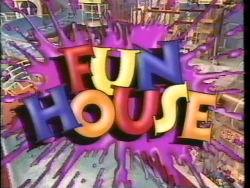
A college sophomore went on a game show audition from his USC dorm room, sat through seven callbacks, and walked out with a job that was supposed to last 22 episodes. A month later it was the number one kids show in America and he was being escorted out of shopping malls by security. And more than thirty years on, the host still cannot get the episode count straight, because the man who lived it remembers 400 shows where the record says 375.
Fun House was an American kids game show that aired from September 5, 1988 to April 13, 1991, hosted for its entire run by J.D. Roth. Two teams of children answered questions, played messy stunts, raced a Grand Prix track, and sent a runner through a two-minute obstacle house grabbing cash and prize tags. Created by game-show veteran Bob Synes as an open competitor to Double Dare, it ran two seasons in daily syndication, then a final season on Fox as Fox's Fun House, 375 episodes in all.
A duffel bag, a hundred-dollar bill, and seven callbacks
J.D. Roth grew up in Cherry Hill, New Jersey, just across the river from Philadelphia, and had been a working child actor since grade school, spending his weekdays auditioning in New York. By the mid-80s he had guest roles behind him on shows he still lists off easily. "I actually thought I was going to be an actor," he told the Hosts at Home web series in 2022. "It turns out, like, I definitely was nowhere near as talented to become an actor." He rattles off the credits anyway: "Certainly, The Twilight Zone was a great one. The Equalizer with Ed Woodward."
He got into USC and moved west, and kept auditioning between classes. Fun House was just another call. "I went on the Fun House audition," he told Hosts at Home. "Seven callbacks later." It came down, he said, "to, like, me and another guy."
What he did to win the last callback is the part he tells the same way every time. He decided he needed a signature line. "I needed a tagline," he said. "I stayed up late the night before the final audition. I would get to the final audition hours before so I could park in the same spot. I would wait until someone would pull out of the spot. That's how superstitious I was about getting this job. I wanted it bad." The line he built, a wish that the viewer's house was a fun house, became the sign-off he used to close the show for its entire run, and, he noted, the British version borrowed it too.
The 22 episodes that became the number one show in America
The order was small and the expectations were smaller. Roth has put the same numbers on it in interview after interview. "Fun House was life-changing," he told the In The Zone podcast in 2023. "I literally went from my dorm room at USC to the cover of Teen Beat in like a month, and the audition was only supposed to be 22 episodes. And after a couple weeks on the air it became the number one kid show in America, and they ordered 195 episodes."
Fame arrived at the speed of a syndicated kids hit. "I go from my dorm room at USC to the cover of Teen Beat magazine in, like, a couple months," he told Hosts at Home. "I would go to the mall and have to be taken out by security. Back in those days, like, that was the norm of what went on because they had no access to you. So when you showed up, man, everyone came."
Living on campus stopped working almost immediately. His call time was 6 a.m. and his roommates were "rolling in at three in the morning," he told In The Zone. He promised his mother he would go back and finish his degree the moment he did not have a show on the air, a promise that turned into a career. "I've had a show on the air every single year since 1988," he said. He now teaches at the USC film school he never graduated from. "It's weird when they're like professor Roth. I'm like, it's J.D."
The show itself: stunts, a Grand Prix, and a two-minute grab
The format was built to be messy and fast, and it was openly modeled on the same territory as Double Dare. Two teams of one boy and one girl each, one in gold and one in red, played three stunts an episode, "frequently ended up covered in disgusting materials such as slime or garbage," and scored 25 points a win, according to the Wikipedia record of the show. Between stunts, Roth threw a giant coin to decide who started, and asked trivia to the teammates sitting out. In the third Fox season, a right answer also earned the right to hit the other team in the face with a pie.
Then came the Grand Prix race, two laps around a track ringing the studio, teams grabbing white and blue tokens worth 10 and 25 points and, in season two, a Token Bank bundle worth up to 200. The winners earned the thing every kid in the audience wanted: a run through the Fun House itself. Sixteen oversized price tags waited inside, six red ones hiding prizes and ten green ones worth cash from $50 to $300, and the team had two minutes and one runner at a time to grab as many as they could. One tag each show was the secret Power Prize, worth a vacation. On Fox, a hidden Glop Clock bought a 15-second bonus.
The money was the tell that Fun House was chasing a bigger swing than its rivals. Where a team on Double Dare or Finders Keepers, per the same record, usually left with around $2,000 to $3,000, a Fun House prize haul "approached and usually exceeded $10,000." The show wore its sponsors on everyone's feet, literally: British Knights outfitted the first two seasons and LA Gear the third, and everyone onstage wore a pair.
Celebrities passed through the mess too. Roth still tells the story of a teenage guest who did not want to get dirty. "I remember standing next to Leo," he told Hosts at Home, "he was just getting started. And he's like ... do we really have to get messy? And I was like, yeah, man. That's kind of the point of the show." That was Leonardo DiCaprio. "He's the nicest kid ever," Roth added.
The Double Dare rivalry, as the host tells it
Fun House and Double Dare were the two kids game shows people actually watched on repeat, and the rivalry was real enough that Double Dare, by the Hosts at Home interviewer's account, poked fun at Fun House on the air. Roth says he never took the bait. "Back in those days, my technique was always to just act like there was no one else there," he told Hosts at Home. He knew Double Dare host Marc Summers, who "reached out to me early on" and "was much older than I was," and there is no grievance in the way Roth tells it now. "I have mad respect ... for him and what he's done in his career," he said, reaching for a surfing metaphor he has clearly used before: "There's enough waves for everybody."
The behind-the-scenes credits ran deep. Fun House was created by Bob Synes, a veteran producer who had worked on Let's Make a Deal, with Synes and Scott A. Stone as executive producers, per the Wikipedia record. When Synes died in 1990, Stone brought in David G. Stanley and the company became Stone Stanley Productions. John "Tiny" Hurley announced the syndicated run before breakdancer Michael "Boogaloo Shrimp" Chambers took over as "MC Mike" on Fox, and identical twins Jacqueline and Samantha Forrest, "Jackie" and "Sammi," were the cheerleaders. A 1989 spinoff, College Mad House, put the same obstacle course in front of college students and was hosted by a young Greg Kinnear.
How the telling has grown over the decades
The paper trail and the host's memory agree on the shape of the story and split on the arithmetic, which is exactly what the stories lane exists to show.
- 1997 and 2014, the reference shelf. The hard numbers enter the record through television encyclopedias, Wesley Hyatt's Encyclopedia of Daytime Television and Vincent Terrace's Encyclopedia of Television Shows, cited in the Wikipedia entry: premiere September 5, 1988, finale April 13, 1991, three seasons, 375 episodes split 351 in syndication and 24 on Fox.
- 2022, Hosts at Home. Roth gives the audition in full: the seven callbacks, the parking-spot superstition, the tagline he stayed up all night to write, the 22-episode order, the DiCaprio moment, the Marc Summers detente. Asked point blank whether there were three seasons, he wavers: "I think we did four. We did three seasons and then one final short season on Fox ... It was a long time ago."
- 2023, In The Zone. A year later he tells it again, and the beats are strikingly stable: dorm room to Teen Beat cover in a month, 22 episodes ordered, number one show in America, 195 episodes picked up. Recounting fans who still approach him, he lands on a different total: "We did 400 episodes."
The drift is worth naming plainly. Roth's tellings are remarkably consistent with each other on the human beats, the callbacks, the tagline, the mall security, and consistent between 2022 and 2023 on the "22 episodes, then 195 ordered" figure. Where they part company is with the record. He counts 195 ordered and 400 aired; the encyclopedias count 375 total. He wavers between three seasons and four when the answer is three. None of that is dishonesty. It is what happens when a 20-year-old lives through a blur of 6 a.m. call times and remembers the feeling of the number rather than the number. The dates and counts here come from the archival record. The rest comes from the man who was there.
The honest bottom line
Fun House was a loud, sticky, sponsor-plastered Double Dare competitor built to move product and fill a daily syndication slot, and it leaned on the same messy-game formula its rivals did, only with bigger prize tags to stand out. It lasted three seasons and got shuffled off to Fox for a short final run before it ended. None of that is why anyone remembers it. It ran on the manic goodwill of a 20-year-old host who wanted the job badly enough to guard his parking spot, and who has spent the decades since telling the story with the same delight, wrong episode count and all. The record keeps the numbers straight. J.D. Roth keeps the feeling, and the feeling is the part that lasted. Remote Control was solving the same problem for MTV that Fun House solved for Nickelodeon: fill a half hour cheaply enough that the network never has to admit it needs something other than music.
Sources
- Hosts at Home, season finale interview with J.D. Roth, YouTube, 2022.
- In The Zone, episode 16, interview with J.D. Roth, YouTube, 2023.
- Wikipedia, "Fun House (American game show)," citing Wesley Hyatt's Encyclopedia of Daytime Television (1997) and Vincent Terrace's Encyclopedia of Television Shows (2014) for air dates, season and episode counts, format, and production credits.
The mess is safely on the other side of the glowing screen down the hall. More show stories live at /full-story/. Related: the messy-game show it was built to beat, the full story of Double Dare.
Frequently asked
Who hosted Fun House?
J.D. Roth hosted Fun House for its entire run, from the 1988 premiere through the final Fox season in 1991. He was a USC sophomore and former child actor when he won the job after seven callbacks, and he still closes appearances with the show's signature sign-off.
When did the Fun House game show air?
Fun House premiered September 5, 1988 and ended April 13, 1991. Its first two seasons aired in daily syndication, and the third and final season aired on Fox as Fox's Fun House, for 375 episodes across three seasons.
What was the Fun House kids game show about?
Two teams of one boy and one girl competed in messy stunts, answered trivia, and raced a Grand Prix track collecting point tokens. The winning team ran through the Fun House, a two-minute obstacle course, grabbing price tags worth cash and prizes, with one hidden Power Prize worth a vacation.
Who were the twins on Fun House?
Identical twin sisters Jacqueline and Samantha Forrest, known on air as Jackie and Sammi, were the show's cheerleaders. Each backed one team, Jackie the gold team and Sammi the red.
Was Fun House a rip-off of Double Dare?
Fun House and Double Dare shared the same messy-game format and competed head to head for the same audience, with Fun House offering much larger prize hauls, often over $10,000 against roughly $2,000 to $3,000 on Double Dare. Roth has said he simply ignored the rivalry and kept mad respect for Double Dare host Marc Summers.
Was Leonardo DiCaprio on Fun House?
According to Roth, yes. He has said a young, just-starting-out Leonardo DiCaprio appeared as a guest and asked whether he really had to get messy, and Roth told him that was the whole point of the show.